cleaning vinyl
November 23, 2009

This weekend was spent almost exclusively collecting firewood and cleaning records. I have been meaning to clean my minimal record collection for a long time. My dad kept on telling us about how much better the records would sound if we only cleaned them. He even ordered us cleaning solvent and new record sleeves and plastic slip covers. And I think that we have had them for a good year…
Finally, Skye and I went over to my dad’s house and got to work. He has a really nice setup. A record cleaning machine, and all the bottles and sponges filled with the right things for the appropriate steps. He gave us a thorough tutorial, and I have made notes to outline it below.
Here is a general outline. I might have forgotten to note some of the specifics, but this should give you the gist of things.
Step 1.
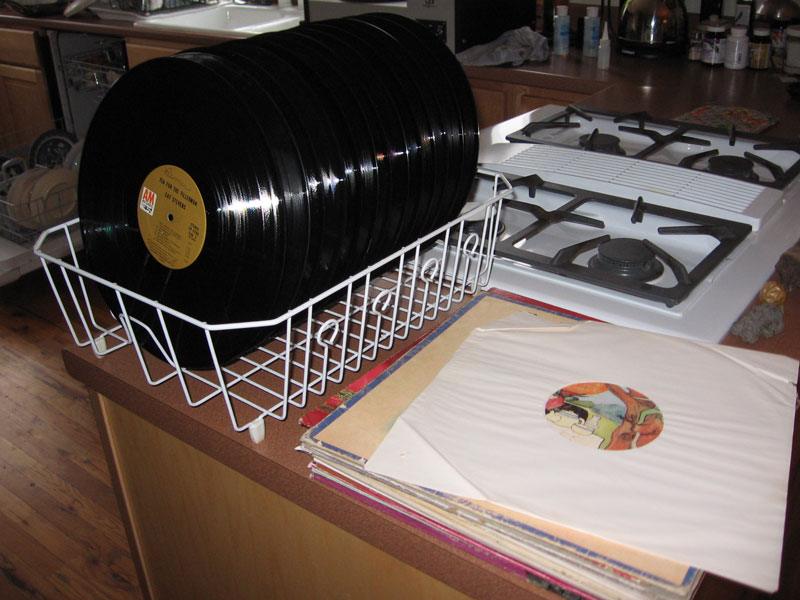
Remove records from jackets and discard old and funky inner paper covers (you can save any original ones with things that might be important on them). Place records into dish rack, starting from the back and taking care to place record with side a facing up. My dad’s setup (aka dish rack) fits 12 records.

Step 2.
Place record on table (a turntable of sorts) and screw the top tightly on.

Start the motor spinning, and soap the record up. The sponge catches the soap as the record turns, evening out the cleaning process. The soap cleans out the dirt in the grooves of the vinyl. An indicator of this is the level of gloss on the record. The above record needs a little more soap in the middle where you can see the streaks in the reflection. We had the whole thing setup under a bright window, and this helped to identify if there was enough surfactant present. During this step the record is also intermittently spun backwards, to clean more thoroughly.
Step 3.

Place the vacuum tube on the record at an angle, and turn on. After one full turn place the “water sponge” down and start washing the soap off with distilled water.The water rinses the record, and then is sucked out through the vacuum tube. When water begins to form droplets you know that the soap is rinsed off (surface tension changes), and the record is clean and ready for the final 2 spins with the vacuum tube. If the vacuum is used for too long, the record will pick up static, which isn’t good, as it attracts dust and other debris right back to the clean record.
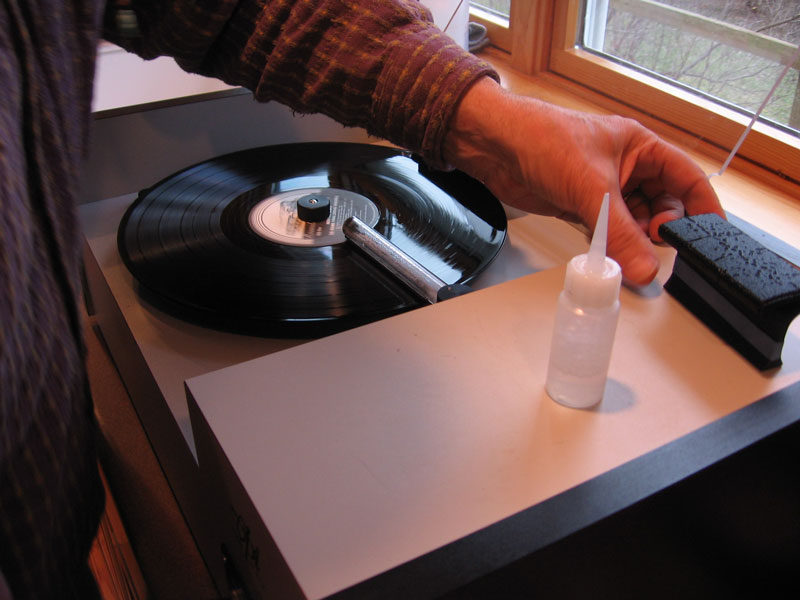
Switch record to side b, clean it, and so on and so forth.
The final step (4) is to replace the clean record in the jacket, using a new sleeve if necessary. The sleeve should be dated, and the cleaning method should be noted for future reference. In my case, November 09, and the soap which was Disk Doctors Miracle Record Cleaner, and the name of the machine (VPI). Then, the newly cleaned record is placed in a plastic sleeve, and you are finished!

Now I am listening to a scrappy old George Jones record that used to sound pretty bad and now sounds much, much better! Cleaning is totally satisfying work!!
slightly broken heart
November 21, 2009
When we were out collecting firewood this morning my dad came up with this beautiful trivet/wall hanging. I remember him making many trivets when I was little, by carefully slicing logs into thin pieces. One year for Christmas he made trivets as gifts for everyone. This one is particularly nice, and we aren’t sure if it will break all the way through, or stay together! It also looks to me as though there are two eyes staring brightly out! The crack down the middle was the home of some ants, so we made sure to carefully remove them all.
Making trivets is really easy. You can slice the wood with a chainsaw, or a simple wood saw (what I would use). The result is always unique, and often very beautiful. Sometimes the trivets will crack when the wood dries out, and this adds more character.
finishing and starting
November 17, 2009
Today was a finishing old drinks and starting new drinks day. There is definitely something about drinks tasting really good after sitting for a while… for different reasons of course! I put up some raspberries in vinegar a month or so ago (when there were lots of them to pick). They sat in my pantry, imparting all their flavor into the apple cider vinegar and red wine vinegar that they were soaking in. Today I strained them and made the syrup for a “shrub.”

A shrub is an old fashioned vinegar fruit drink. I have found lots of different recipes and variations, and the recipe that I used was from The Joy of Jams, Jellies, and other Sweet Preserves (as per usual). I strained the raspberries from the vinegar by passing it through a damp cheesecloth, and then I boiled the resulting raspberry vinegar with some sugar. (I am a little concerned that my house will smell strongly of vinegar and raspberries for a while after the boiling process.)

I tried a teaspoon full of the syrup straight, and it nearly made me choke it was so strong. I added the syrup to water, and it turned into delicious, uniquely flavored, zingy drink. It is almost a better drink for warm weather, so I think that I will try to bottle some of they syrup up and save it for the summer…

On the other end of things, I started a batch Vin de Pamplemousse (I like to think of it as pamplemousse juice as it rhymes nicely), a recipe from Saving the Season, my favorite blog on canning. The recipe, which takes about 40 days to mature, has been conveniently posted about 40 days before the New Year..

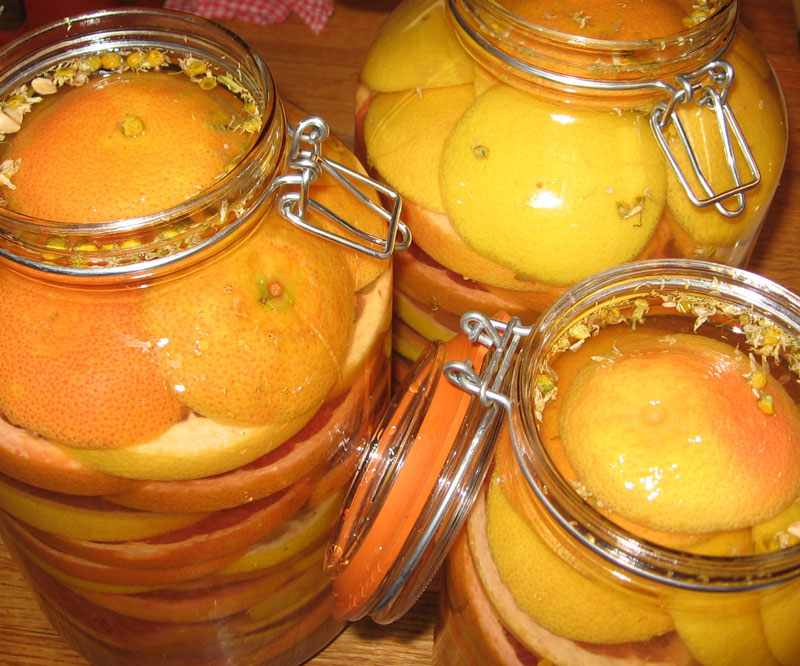
The recipe calls for a whole bunch of grapefruit, sliced and placed in large jars with some vodka, sugar, lemon, chamomile, vanilla, and a whole bunch of white wine. I made a single batch, which filled two 4 liter jars, and one 2 liter jar. The process was really fun, slicing and gently crushing the fruit, and releasing the fragrance of the vanilla, citrus, and chamomile. I am really excited for this (warming) drink to be ready!
sunday morning knitting
November 15, 2009
I woke up this morning and settled right down by the fire to knit. There is a lovely little couch, right next to the stove that currently is missing all of its cushions, but does have a sheepskin sitting on it. I got out my two most current knitting projects, and set to work. I am taking two classes at the store, one to make a little lace baby bootie, and the other to make a Tomten Jacket.
Both projects are fun and engaging, with the sweater taking up more brain power, as I am adjusting it as I go to make sure that it will fit well. I am currently working on the sleeves. The pattern, designed by Elizabeth Zimmerman (one of the best knitters EVER) is knit modularly, and while it works really well for a child’s sweater, there are some adjustments that help for the adult version. I made most of it according to the plan, with a few mistakes that I actually like the result of. I was inspired to adjust the sleeves after reading about the version knit by Jared Flood of Brooklyn Tweed.

I have finally settled on working short rows for a while and then working straight, after trying it on several times this morning, and then again in class with lots of helpful comments and views. There are three of us in the class making adult sweaters, and it is really fun to collaborate together, changing and adjusting the pattern to suit our needs.

I spent a lot of time working on the join of the sleeve to the sweater body. In the pattern you are supposed to keep the underarm stitches attached, and then knit two together at the end of each row, thus joining the set in sleeve to the body. I didn’t like the results of doing it this way because the two sleeves were different from the front view and back view. In order to make them the same, I took a technique that I learned from Dolly in a modular knitting class and adjusted it so that I was decreasing on either end of the right side. This was a little tricky to figure out, but the finished result is very similar on both sides of the sleeve. I have been working on writing up the technique, but am not completely finished yet..

The second project, the baby bootie was designed by Jeanne McCanless, of Oskaloosa. Jeanne is another of my favorite knitters! She took the pattern from a baby bootie that someone brought to her and figured it out. The unusual design is fun to knit, and a great tiny project to have along (as opposed to the huge tomten jacket). And it is published in this year’s holiday edition of Interweave Knit Magazine!! We are so excited about this!

The lace is knit in a “T” shape, and then the bottom is picked up and knit in garter stitch. The finished product definitely looks like it was harder to knit than it actually is. It is a perfect gift project. I am making the booties in red, as opposed to the traditional creme, and am loving working with the yarn!! It is Jawoll, a combination of wool and nylon, made is Switzerland, and perfect for socks of all sorts. It comes with a spool of reinforcement yarn for the toes and heels inside the skein! (I am tempted to start a pair of red and white striped socks or legwarmers when I have finished the booties.)
tunisian tagine
November 15, 2009
Last summer, when we were in New York at the Fancy Food Show we met the owner of Moulins Mahjoub, a Tunisian producer of olive oil, olives, pepper and tomato pastes, and sweet preserves. We fell in love with the products, and ordered them right away for the store. When they arrived, we weren’t really sure what to do with them. We had a few recipes, and a vague idea about the uses of some of them, but we really wanted to learn more about the food, and food culture. Terry, a customer from Burlington came in one day and was looking at our savory food products, and happened to mention that she had a friend from Tunisia. One thing led to another, and we ended up having Cecile Houle (a pastel artist from France and Tunisia) come and do a cooking demonstration for Art Walk, as well as a cooking class! I really loved the food that she made. So much so, that the next day, on the way home from work, I stopped and gathered all the necessary ingredients to attempt to recreate some of the dishes that she made. This is the Potato Tagine, seasoned with pickled lemons, salted mountain capers, and harissa.

The recipes are simple, but the combination of ingredients are unique, and delicious. One of my favorite combinations is of fresh cilantro and parsley together with onions, garlic, and other spices. The mixture is unique, and smelled so good while it was being prepared!
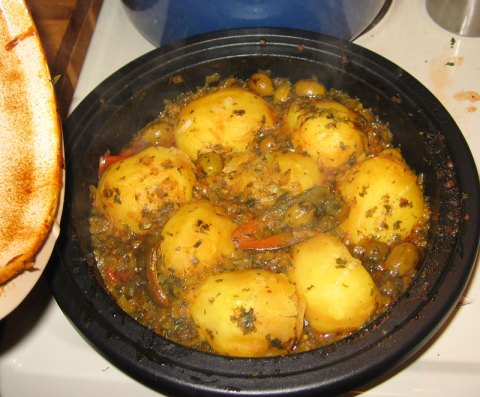
I ended up with a huge tagine full of potatoes as well as an entire 5.5 liter pot of stew…I had to call in the reinforcements to eat everything, and even then, it lasted several days. I tend to make too much, but it is usually eaten by someone.
pizza, peels, and burns…
November 14, 2009
The last few times I made pizza I used my cast iron pizza pan. It heats up really well, and retains the heat for quick, even cooking. I usually preheat my oven to abut 500 degrees with the pizza tray in there. Then, I place the pizza dough in the oven for a few minutes first, and then remove it, add the sauce and cheese, and finish baking. The only difficulty has been in getting the pizza (rising on the counter) into the oven and neatly onto the preheated pan. 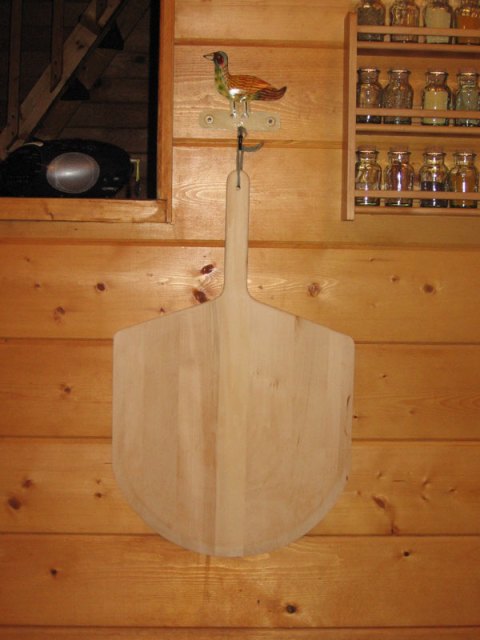
So…I brought home a pizza “peel” from the store last night to help with this process! I have been wanting one for a long time, and finally got around to getting one. It is really handy, because you can roll out the dough and leave it to rest on the peel, covered with cornmeal (I forgot to get some so I used a liberal amount of flour). When the pizza is ready to go into the oven, the long handle is perfect for sliding it in without too much awkwardness!

My dough recipe is currently located on two sticky notes. I copied it out of my sister’s journal from Italy. I usually make about 1/3 of the above recipe, and that is a huge pizza! If I preheat my oven to 500 degrees, I usually don’t cook it quite as long as the recipe says either. I just watch the pizza like a hawk until it looks finished.

Here is the dough. According to Erika, our pizza teacher, the dough should have the consistency of an earlobe. Plenty of kneading and plenty of olive oil helps with this. After I kneaded the dough I rolled it out and placed it on the peel to rise. I then chopped some fresh mozzarella cheese into chunks, and set aside. For sauce I used a jar of tomatoes that I put up this summer!! 
Last night I made the mistake of poking the top of the pizza dough while it was in the oven. There was a large bubble, and I popped it and seared the back of my finger with steam…a little reminder NOT to stick your fingers in a hot hot oven!

Here is the finished pizza. It is a little bumpy because of the big bubble, but it tasted really yummy. I think that if I had used a little more water in the crust it wouldn’t have turned out quite as crispy, but it was good anyway. My mom and I ate it with sauerkraut on top. Sauerkraut seems to be sneaking its way into lots of different dishes these days…
canning kraut
November 11, 2009
I came home last monday night to a “matured” crock of sauerkraut. I left it with my mom for this last week, and when I returned, it was a lovely golden color, tart, and crunchy! I started the sauerkraut about 3 1/2 weeks ago, and it sat in my kitchen, periodically scenting the whole house. I had to watch it, making sure that the top remained clean throughout the process of fermentation. Making sauerkraut is much easier than I had initially imagined. It is amazing to me how simple a recipe can be, yet taste so good! Basic sauerkraut is made with salt and cabbage. Thats it!
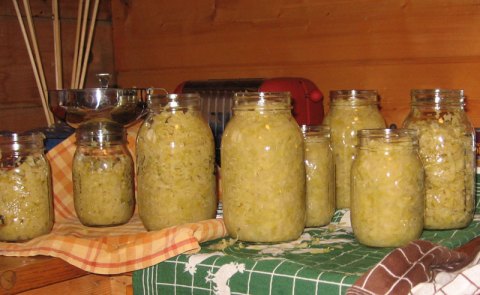
Fully fermented sauerkraut was traditionally placed in a cool location to spend the winter. Now days, around here anyway, it is canned, frozen, or eaten when it is finished. I used a recipe for processing my sauerkraut from The Joy of Pickling. The remaining kraut I have put into jars to hand out to family (and the little left is going to go in the freezer). I know that sometimes freezing is better, but for some reason I really prefer to can things. I guess it has to do with the possibility of a storm leading to a power shortage, leading to frozen goods going bad…
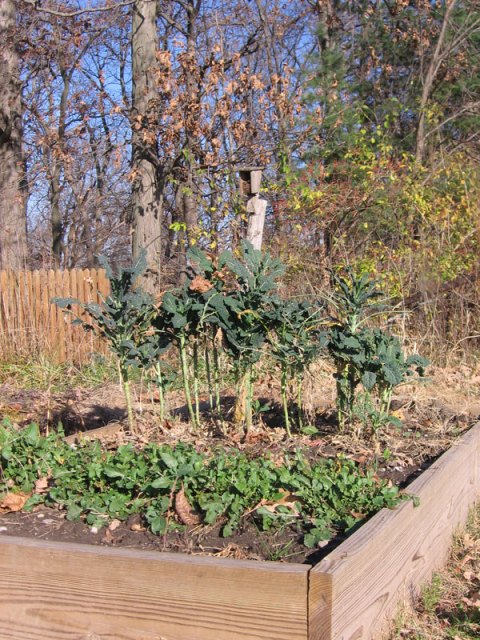
I was out of town for a week, and when I returned, I imagined that everything in the garden would be brown. Fortunately things disappear in stages. The arugula, kale, thyme, and parsley seem to be holding out for as long as they can.
My two favorite November fruits, pomegranates and persimmons, were ripe when I was visiting California, and I made sure to bring as many back as I could. (We picked some and purchased some from farmers, and from the farmer’s market!)
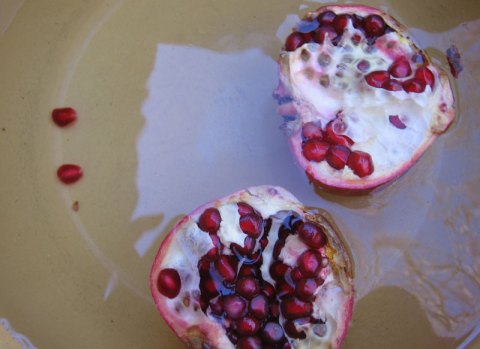
Pomegranates must be my favorite fruit. There is something SO satisfying about carefully peeling each seed away from the bitter white surrounding it, making sure that each seed remains whole, and then collecting the seeds in a glass, or perhaps eating them one by one.

There is a trick however, if you ever find yourself without the time to spend on carefully peeling each seed. Simply fill a deep bowl up with cool or room temp water. Score the outside of the fruit all the way around in several sections with a knife and submerge the fruit in the water.
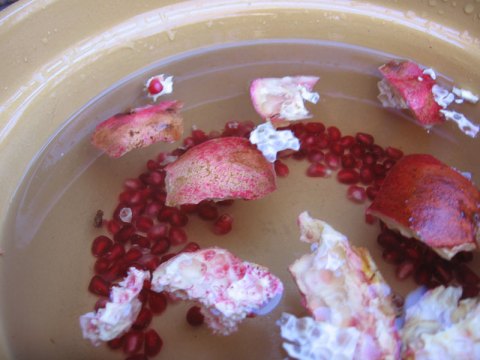
When the pomegranate is submerged, carefully break the pomegranate sections apart, keeping the fruit under water so that the seeds wont burst and spray you with the bright red juice. When all the seeds are removed from the white, the seeds will sink, and the white will float to the surface to be gathered and discarded. Then remove or strain the seeds, and gently dry with a kitchen towel. The entire process is done under water, and this helps to reduce or eliminate staining, and keeps the seeds separated from the inedible white part!

For lunch today, I wanted to mix fresh Iowa greens with fresh California pomegranate. I picked some of the lingering spicy arugula, and topped it with sweet ripe pomegranate seeds. For salad dressing I spooned on top some raspberries that I preserved in apple cider vinegar about a month ago. Then I drizzled the whole thing with a little bit of olive oil. And a sprinkling of salt and freshly ground pepper. Yum! This salad is also really good with the addition of fresh crispy pear slices.
how to jump out of a box
November 5, 2009
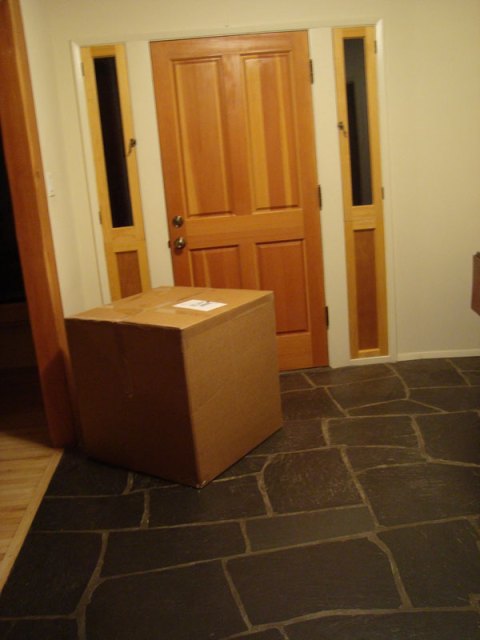
fig. 1
1. Print a UPS label and void the shipment.
2. Purchase a large ummarked box and a roll of tape.
3. Place the box in a believable location. (fig. 1)
4. Have a friend tape you into the box.

fig. 2
5. Pretend like you are an inanimate object in the box, and wait.
6. Make sure that the friend supervising the opening of the box has the recipient (a) open the box, and (b) open it with a relatively dull object.
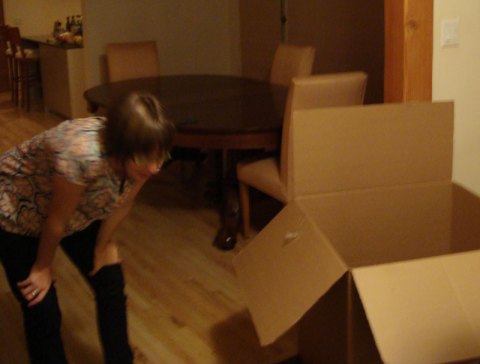
fig. 3
7. Wave your arms and legs around when the box is opened. (fig. 2)
8. Make sure that the hyperventilating recipient (fig. 3) doesn’t pass out. Supply a cup of tea, or perhaps some Rescue Remedy.
firewood (logistics)
November 2, 2009
My dad and I collect firewood in the fall. It seems to have gone from canning season (I canned what might be one of my last jars of spiced pickled pears last Thursday) to firewood collecting season. The weather is perfect, and I actually look forward to spending all Saturday or Sunday morning outside.

Here is how it goes. My dad scouts, measures, and takes care of general logistics, which there happen to be a lot of! He locates the logs and figures out how to winch them up the hill to the cutting/splitting station. He works with Yogi, who is usually wielding the chain saw. They are on their way up the hill here, probably headed to get supplies to chop things. My dad got a new chain saw this year. It is about twice as big as our old one, and Yogi is able to saw much larger logs. I didn’t get any pictures of the chainsaw in action this week, but will post some more later.
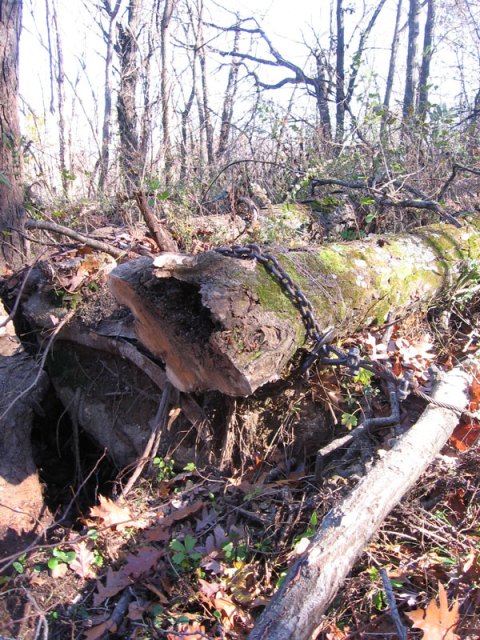
This particular log is tied up with the chain and hook at the end of the winch. The winch is attached to the Power Wagon positioned (stuck) up the hill. As the winch reels in the cord the log is pulled up next to the splitter where it is sawed and passed on to me.

Yogi is pushing the log away from the standing tree to the right. It was stuck here on its way up. Sometimes the logs need to be rolled all the way over, and sometimes they need to be adjusted just a little to make it around trees and other barriers.
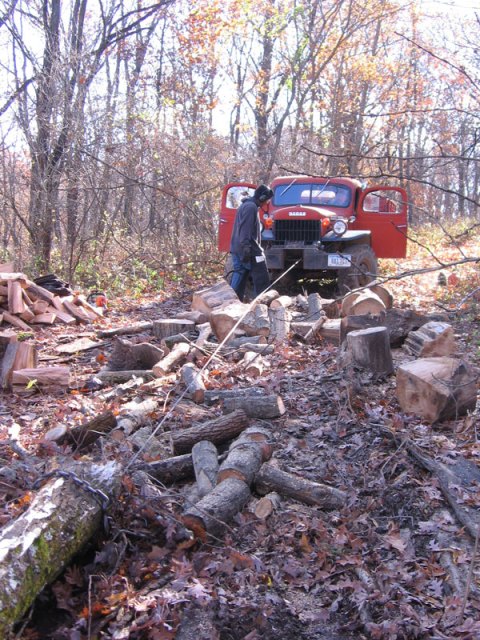
One of the most important elements of our operation is the Dodge Power Wagon. We use it for hauling wood, hauling the splitter, winching large logs out of the woods, and storing supplies.The Power Wagon is a beast! It was built sometime in the 50s (I think), and is still going strong.
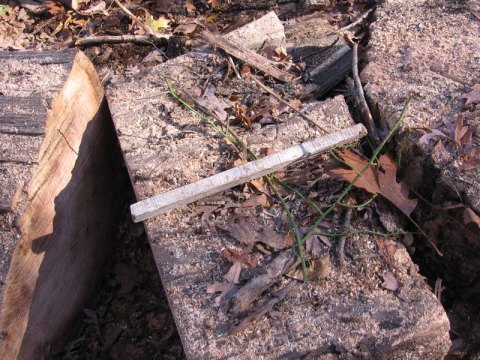
This white stick is the measure of how long the firewood needs to be. My dad measured exactly how long the logs could be and still fit into the stove, and then cut the measuring stick accordingly. My dad usually holds the stick against the log, and then Yogi cuts a mark into the log, and then goes back and chops all the pieces at once. It is a two person process, for efficiency as well as safety. One of the big rules that we have is that no one is to operate the chain saw (or splitter) alone!!

The splitter has been staying out in the woods this fall. We cover it up with a tarp when we aren’t using it, and then it is ready to go when we return. This happens to be my tool of choice. I love splitting the logs, making sure that all the pieces will be a good size for burning. It is a little like a puzzle, trying to figure out where to start splitting, how to avoid knots in the logs, etc. And when you are operating the splitter you get to smell the freshly split wood. There is nothing sweeter, and more reminiscent of fall than the smell of freshly split wood (mixed with exhaust fumes from the chainsaw and splitter of course). There are often beautiful colors, reds, oranges, and the occasional dark brown of walnut (not the best wood to burn, but exceptionally beautiful when freshly split).

My dad splitting some troublesome pieces. Sometimes when the logs have a big knot I pass them on to him and he somehow manages to break them up into nice little pieces.

A freshly split piece of locust happens to be the home of some carpenter ants. The pieces that have the ants are put in a separate pile to be used quickly, or to wait a year for the ants to move, so that they don’t invade and eat the woodpile/house.
 My dad, the man behind all the operations, with his faithful truck!
 living in the woods and making stuff