two more socks at once (this time on double points)
February 18, 2010
More socks…I just started another pair of two socks at once on one set of double point needles. One sock is knit with the yarn held in the left hand, and the other sock is purled with the yarn held in the right hand. The pattern is in an Piecework Magazine, and has been recently re-released in their single issue magazine Knitting Traditions, which is awesome! My favorite bit about this particular pattern is that it has been referenced in many old knitting magazines as well as in War and Peace! That was all it took to get me inspired! That and the possibility to do something new and tricky, involving socks.
Maybe too tricky…

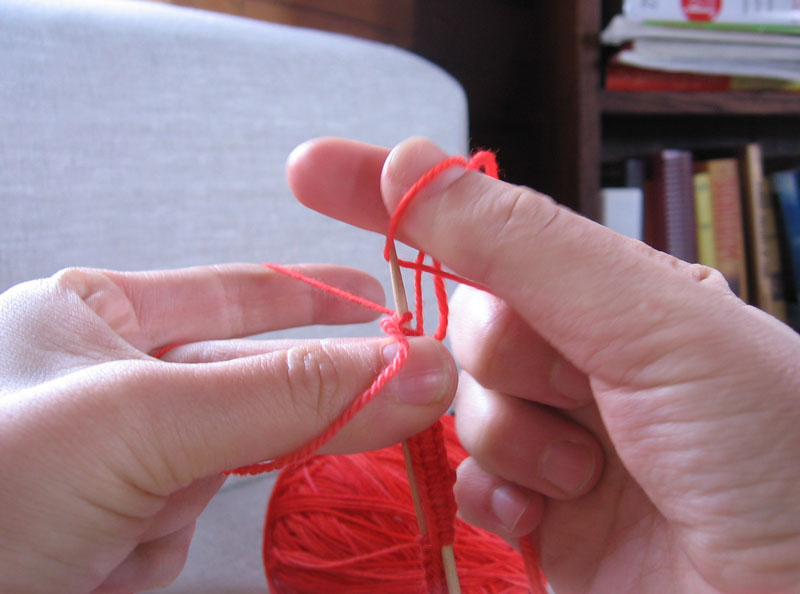

I cast on for both socks at the same time, using my right hand and left hand mirroring each other to cast on.

The right sides of the cast on edge were on the outside, and the wrong sides were together, so I had to twist the stitches so that they were opposite, as the socks are knit with the right sides together. I got through the cast on and knit 2 purl 2 ribbed border with several mishaps, and learned to make sure and check my work REGULARLY so as not to accidentally connect the two socks…

The purled sock is a little bigger, and I am worried that my gauge is significantly different from knitting continentally to purling English style. I am going to keep on working on it for a while and see what I can do…
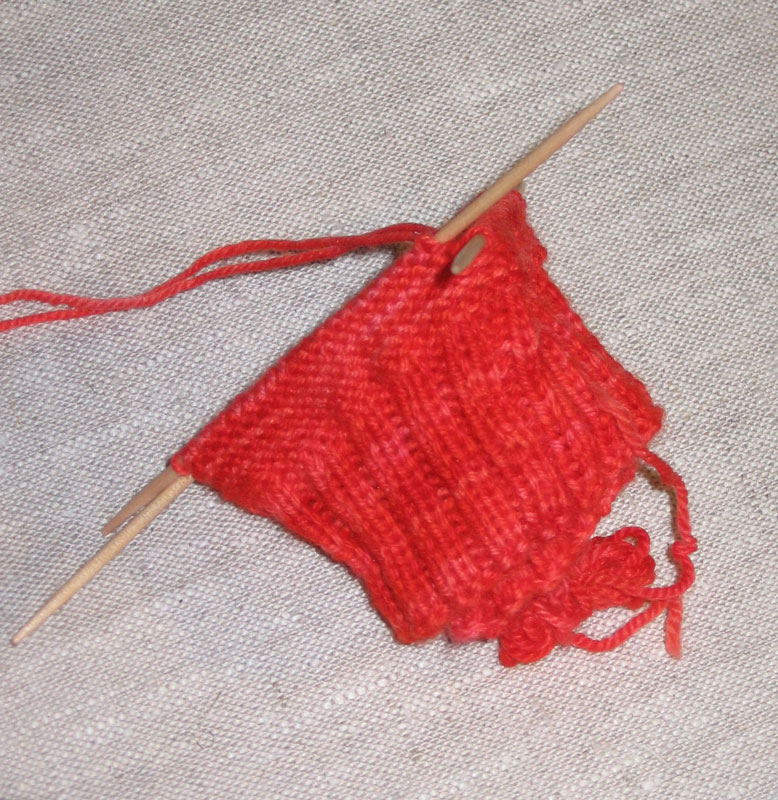
Fast forward a few days..
I ripped out socks numbered one and two, as I am pretty sure that I would have had two distinctly different sized socks if I had continued. The purled sock (on the outside), worked with the yarn in my right hand, was coming out much larger.

I also decided that I would like the socks to be ribbed the whole way down. This means that I would have had to constantly be switching between socks, as well as stitches, which is tricky! It didn’t make sense for me to spend that much time tinkering with this particular project. I ripped out the socks, and switched to one sock at a time.

I finished one very orange sock, measured the amount of yarn that I had left, and re-knit the top and grafted the new part onto the old. There is a bit of a line where I grafted the two parts together, but this way I can use all of the yarn in the ball, and have super long ribbed socks. They come about 2/3 of the way up my calf!

Of course I have one finished sock, and one sock 1″ of the way finished…
I haven’t given up on the two socks at once on one set of double points. I am going to try again, this time using a multicolored yarn, and work really hard to keep my purl stitches tight. Will post when I do!
two socks at once (on one very long circular needle)
February 14, 2010
Sometimes I like to make two socks at the same time. There are benefits and drawbacks, but overall, I enjoy the process and it seems to keep me entertained. Back to the Valentines day theme (I love a holiday that involves pink, red, orange..), I was feeling inspired to make another pair of pinkish socks. And this was a yarn that I haven’t seen worked up. It is a trekking yarn, made in Germany by Skacel, and this particular variety is 80% wool, 20% bamboo (or something like that). I haven’t made socks with bamboo yet, and I love trekking yarns, so thought this might be fun. We only ordered one bag of this yarn for the store and I couldn’t help myself!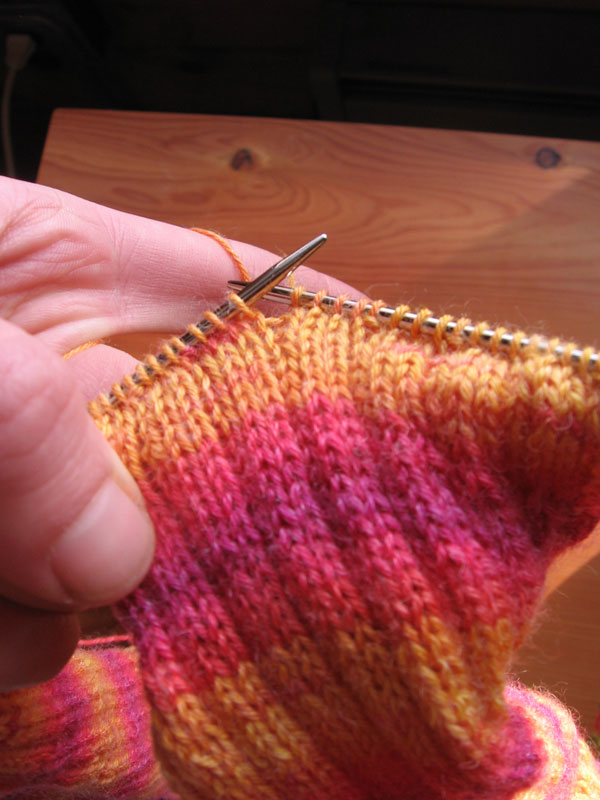
Knitting two socks at once feels like it takes a little longer. Sometimes it seems like the process takes twice as long, as each sock is knit on every round. But at the end, both socks are finished! Kind of a Big Deal! (seriously..) I set up my socks so that the yarn is coming from the inside of the ball for sock number one, and from the outside of the ball for sock number two. Sometimes this involves snipping and weighing the yarn, but in this case I made the socks reverse, and didn’t bother to adjust where they started. Its fun to be random on where the self striping yarn starts. (Its also fun to be selective.)

The socks are cast on, one at a time, and then knit, one row on sock one, one row on sock two. I am working the heels, first the flaps, one row on each. The heel is turned, one sock at a time. For picking up and knitting the gusset, the socks are then worked one round sock one, one round sock two. The gusset always feels like it takes forever for me. And when there are two socks at once thing, it takes forever times two. After the heel is all the way turned, I usually feel like I am home free. The rest of the foot and toe work up quite quickly, and as a project nears the end it seems to pick up speed as well. (Maybe some sort of terminal velocity thing…)
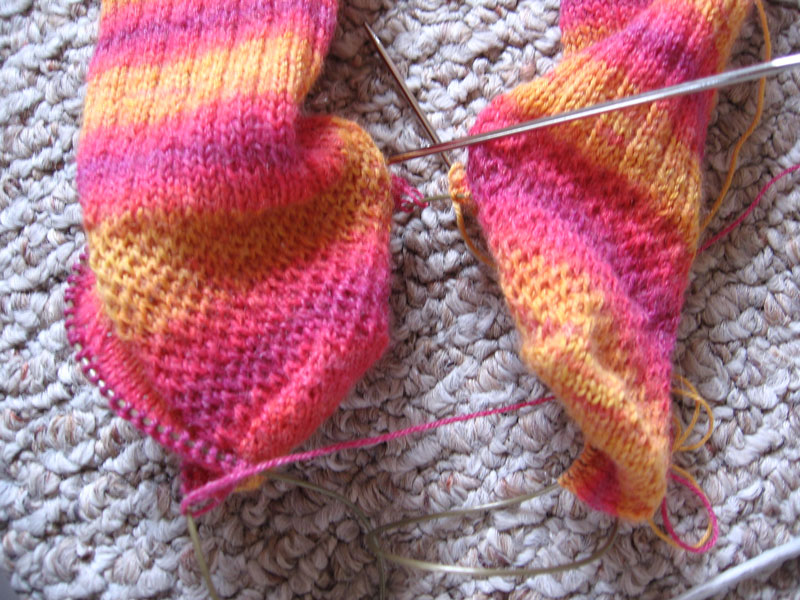
And so, knitting two socks at once does sometimes save me in the end. I have two socks, instead of one lingering sock, sadly waiting for its match.
center pull ball
February 9, 2010

My mom taught me how to make these. There are times that you need a ball of yarn that can be pulled from both the inside and outside. I really like to wind my balls of yarn by hand, and this particular technique makes it possible to have both a hand wound, and center pull ball!

Start by taking off the ties that bind the hank. It is important to take care not to tangle the ball of yarn, as this can quickly turn into a disaster. (Never knit from an unwound hank of yarn!!)

I lay the yarn on the floor, sometimes on the back of a chair, or over my toes, to keep the threads straight.

The yarn is wound around the thumb. I hold the inside tail with my fingers so that it doesn’t get lost, and start winding around first the thumb and one finger, and then add more fingers as I go.

It is really important to keep the ball soft, not super tight. I find that wrapping the yarn around my fingers and then slipping them out every few wraps to work well for this.

As the ball gets bigger, I wrap around more fingers, to keep the tension of the ball even. If the ball is too tight, it could result in stretching the yarn, which can result in altering the tension of the finished product.
I keep rotating the ball every 10 or so wraps. This is to keep the structure and integrity of the ball. If you wrap too many times in one place, the ball can come apart more easily. It is better to do fewer wraps, and rotate a little each time (kind of like a machine made ball).

After a while the thumb begins to dissappear. This isn’t a problem, just as long as you keep the base of the thumb defined..

I eventually end up wrapping 3 or 4 of my fingers under the yarn as I go.
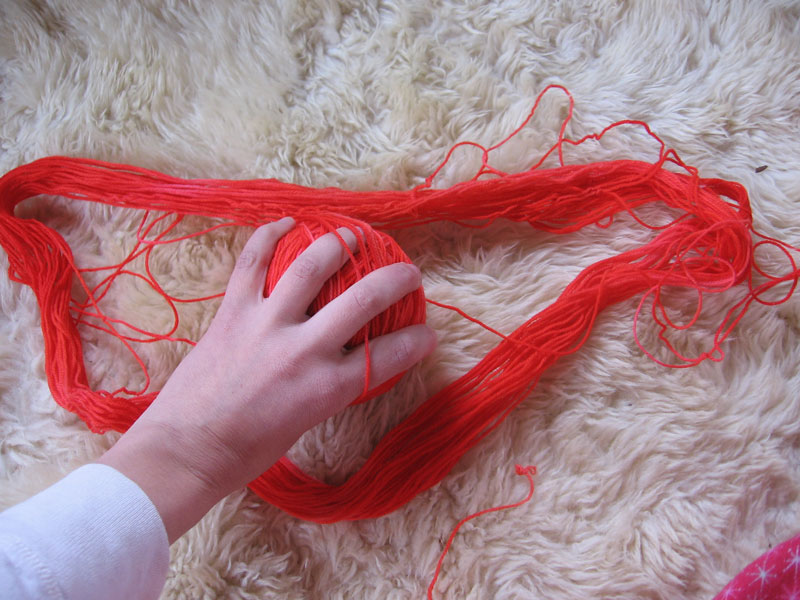
It is always fun to watch the ball get larger as the hank of yarn shrinks. It is especially important to make sure that the hank does not become tangled towards the end. (It is tricky to untangle yarn with a large ball of yarn attached to your thumb too…)
swatch hat
February 7, 2010
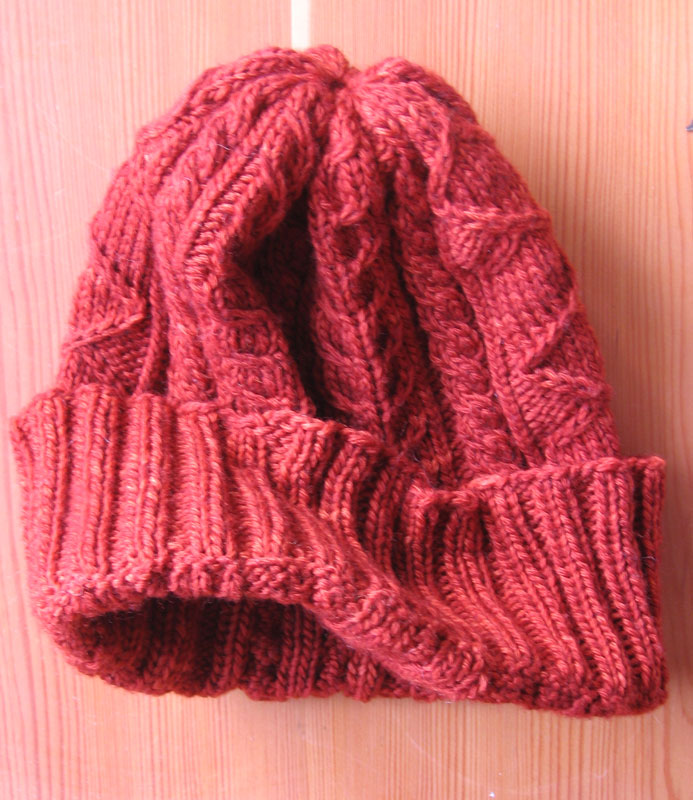
I have had a bag of sport weight Koigu yarn squirreled away on the hold shelf at the store for a while, thinking that I would use it for a sweater. The color is a beautiful, deep, rusty orange (hard to photograph…), and I just love it. When my friend Emmy suggested that we make a saddle shouldered cable sweater, designed by Elizabeth Zimmerman (and her daughter Meg too?), this yarn immediately popped into my head. The pattern is a loose description for how to make the sweater, and it is strongly suggested that you knit a large gauge swatch. She even suggests knitting a gauge hat, or tube, knit in the round as the sweater is, to more accurately measure the gauge. Good plan! I had a sneaking suspicion that the yarn, even thought I loved it, wasn’t my color. Turns out the hat is perfect for my mom. So I am now shopping for a new yarn, and my mom has a new hat!

The hat is made from a combination of cable patterns, including sheepsfold and herringbone. To set off the cables, I added several purls, twisted knits, and a 2 by 2 cable. The additions to the larger cables also work to adjust the size of the finished sweater.

I knit the tube swatch on size 6, 24″ circular needles. It was a little tight working on the 24″ needles for a hat, but I wanted to use the actual needle size and length that I would use for the sweater. (16″ circular needles often have shorter needles, and I was worried that this might change my knitting.)
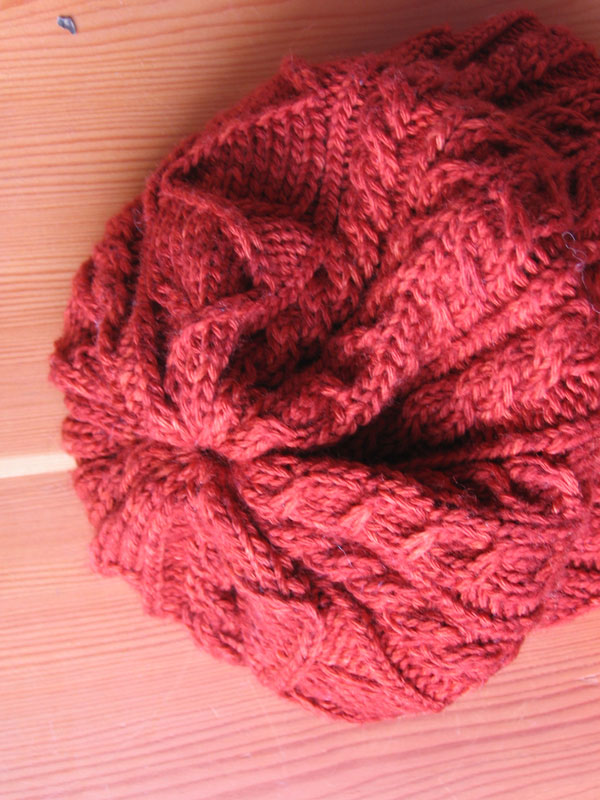
To close the top of the hat, I decreased dramatically over the last few rows, and threaded the final stitches through a sewing needle and pulled tight. There is still a little hole in the top of the hat, but hopefully with a little blocking it can be disguised.

At the bottom edge of the hat I picked up 90% of the stitches (9 out of every 10). I worked a knit 2 purl 2 rib over these stitches until I ran out of yarn.
Overall, the hat was a perfect swatch, to figure out how the patterns worked, how the yarn worked, how the color worked, etc. And one finished hat is the result!
socks and valentines
February 6, 2010
I started a series of socks in December for Christmas stockings, or some sort of decoration, and never managed to finish much of them. A few weeks ago, I picked up one of the red and white striped socks I did manage to complete, and decided that I could probably finish the second sock pretty quickly, and turn the socks into some sort of Valentine thing. I love excuses to finish things. They come in handy when a project needs a little more motivation to complete…
So the socks are for Valentines day, or any day that I want to wear something red, striped, warm and woolly.

The pattern is a basic sock with a traditional heel and toe. The yarn is Jawoll, and I used size 1 1/2 brittney double points. I cast on 60 stitches, and knit 8 rows of each color. (There is a red ribbed border at the top too.) For the first sock, I carried the yarn straight up the back when I switched colors.

For the second sock I twisted the yarn in back every few rows so that the carried yarn didn’t pull too tight. I am hoping that the first sock will be ok, and that the carried yarn will felt a little to the sock and not catch on toes..
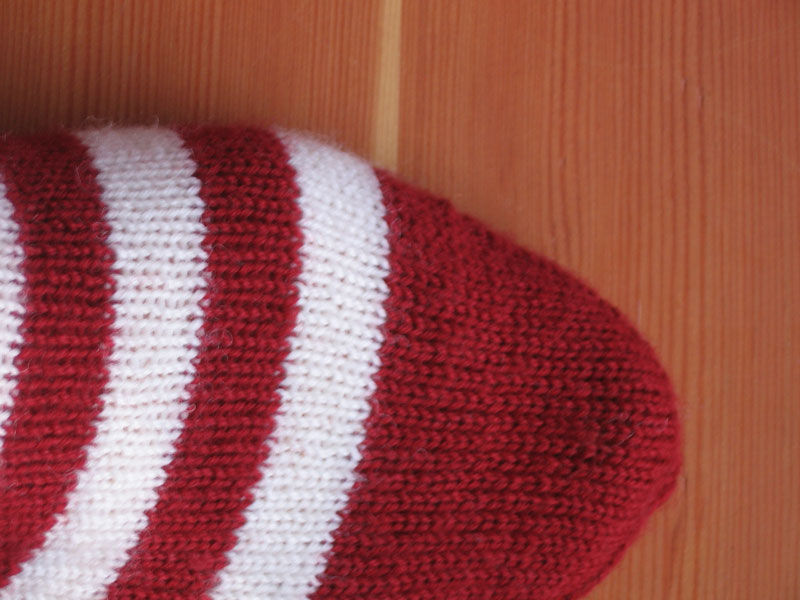
I finished the toe a few times, first making a smaller bit of red, but then decided that it needed the larger showing of red to make a substantial finish.

The final product is cheery, and should be nice to wear for the rest of the winter!
hoodless wonder
January 22, 2010

I finished the tomten hood a few days ago, grafted the top stitches, and then decided that it was too much…too heavy, and bulky, and I wasn’t even sure that I would use it. I love hoods, but the idea of a knitted hood, potentially not very windproof, and possibly saggy, had to go. I went back to knitting the stand up, possibly flop down collar, and it worked out really well. I am now kind of obsessed with wearing this sweater/coat. I feel like it is a bit of a sheep wrapped around me. Toasty warm!

To finish the coat, I made a collar that is about 8 inches long, and it folds over. I then picked up the stitches along both fronts and knit 6 rows (3 garter stitch ridges on the front) and then cast off. I was planning on adding a zipper to this, but I am now not so sure. I kind of like the idea of buttons or toggles of sorts. I will probably wear it around for a month or so before deciding…
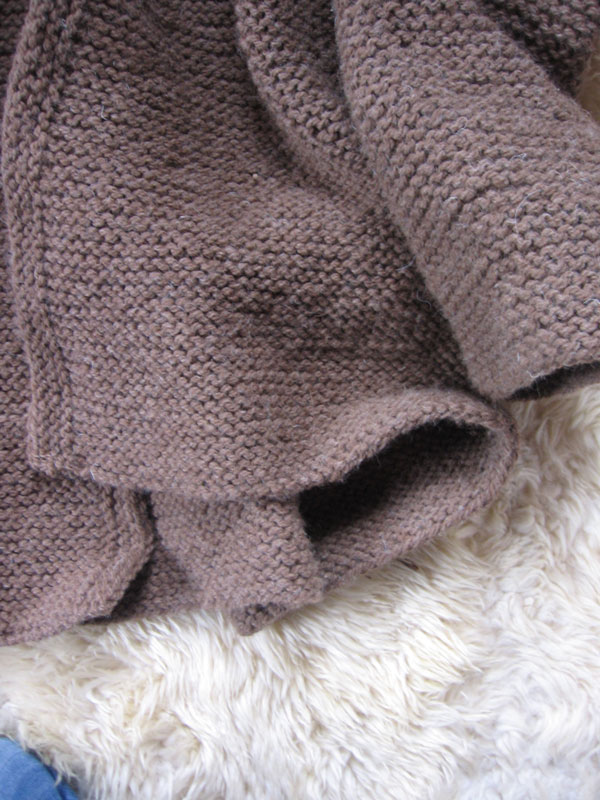
Elizabeth Zimmerman has to have been one of the most amazing knitters ever. All the little features of this jacket come together so well. I particularly like the short row shaping in the back, which makes the back of the sweater just a few (important) inches longer, and keeps my back warm and covered!
neck cozy
January 14, 2010
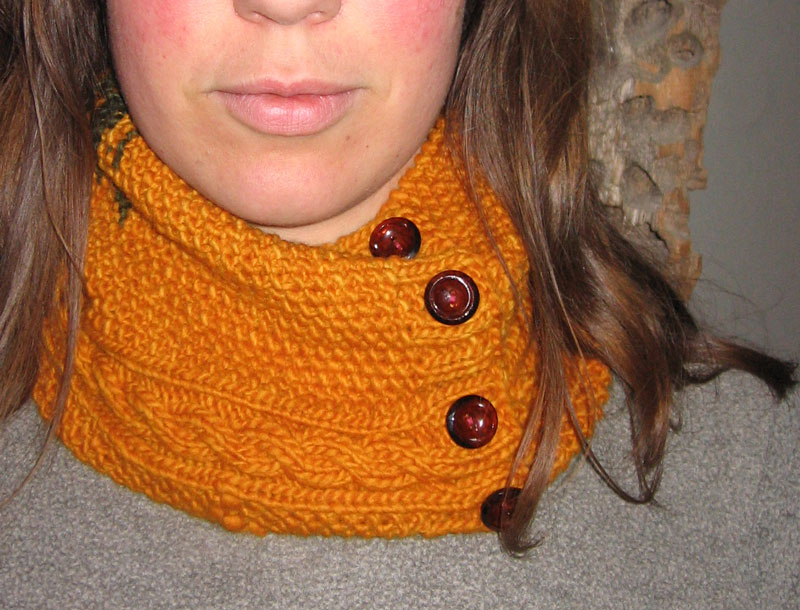
I have had this ball of yellow/orange yarn floating around for several years. I think that I used part of it for something, but I can’t even remember…
A few days ago (back when it was really cold) I picked it up and started to make a neck cozy (a sort of scarf that isn’t too long, and buttons around the neck). I knit in seed stitch, on size 8 needles, and added a little cable up the side to keep me entertained while knitting. (After working on the garter stitch tomten jacket I needed something more engaging.)
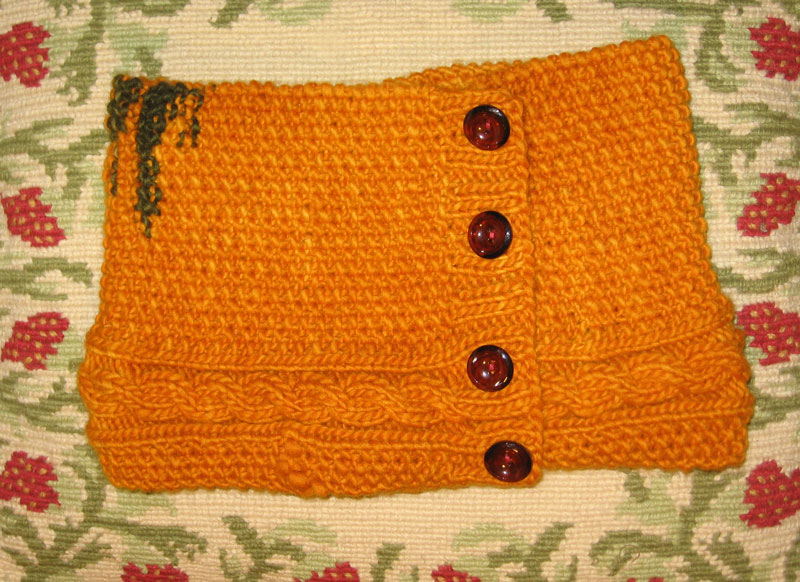
The cable also worked to my advantage by stretching out the bottom of the scarf. It is now nicely shaped and fits around the base of my neck more easily, without my having to increase, or do any funky short row shaping!
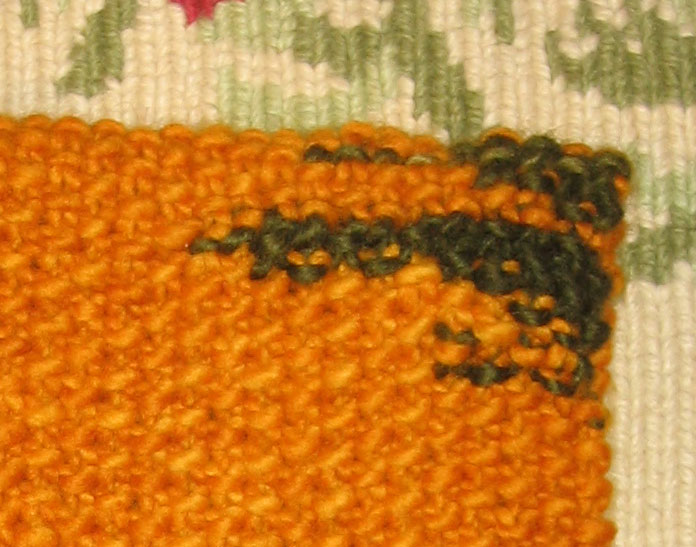
I knit the scarf in super soft Malabrigo, and the seed stitch shows the subtle variations of color in the hand dyed yarn. I added a little scrap of green on the edge just for fun, and to use up one of my tiny scraps..
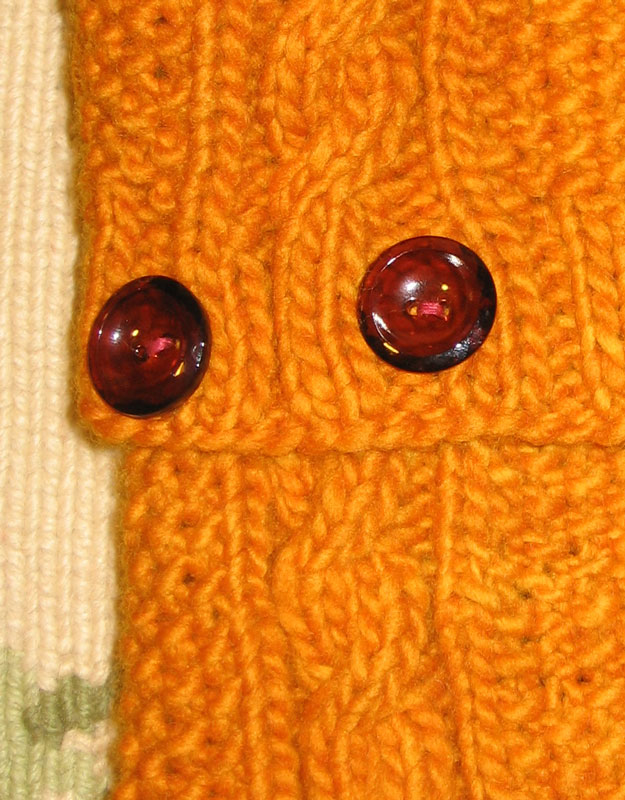
To finish the scarf I ribbed a few rows in knit 2 purl 2 ribbing, and then added buttonholes, and more ribbing. I sewed on 4 glass buttons from Germany (via At Home Store). They are brown and shiny, and add a bright little detail.
(Some people knit tea cozys, but I guess that I would be in the category of people who knit neck cozys.)
To download pattern, click here.
tomten sleeves (again..) and onto the hood
January 11, 2010

All our cold weather, and being stuck inside sick means that I finally got around to ripping out my trial (and error) tomten sleeves. The football shoulder and the too skinny sleeve are gone. I ended up with two sleeves, pretty much identical in dimensions, and a little on the big side. I decreased two stitches every 4 ridges, instead of every three as I was using a yarn with a smaller gauge than called for in the pattern. In hindsight, I think that I could have decreased every 4 ridges, and then every 3 ridges, and back and forth until I used up all the necessary stitches. I do like that the decreases ended right at the cuff though. It just happens to be a rather roomy cuff…
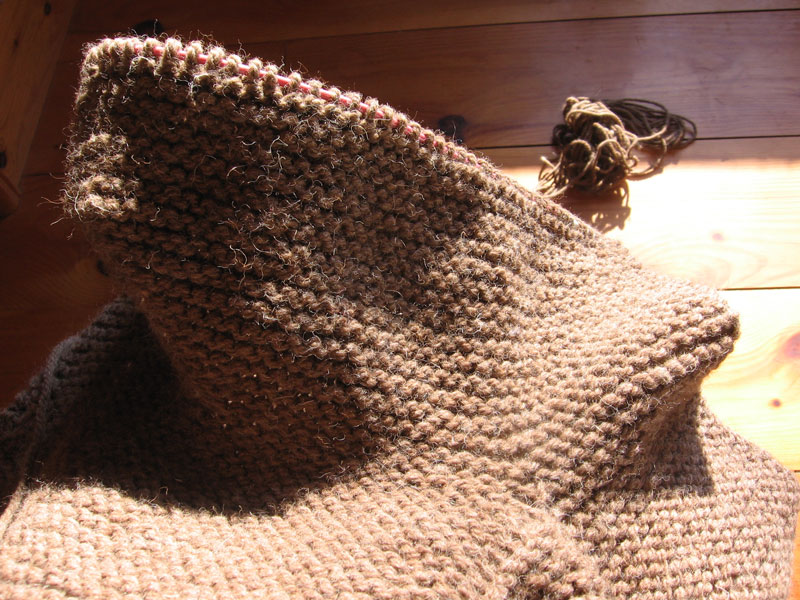
And now on to the hood! I have started the hood, but think that I might rip it out and redo it as well. I made it pretty much according to the pattern, although I grafted 4 stitches on either side of the shoulder instead of picking them all up. (image below)

If this hood doesn’t work, I think that I am going to go back and decrease a little around the back of the neck to create a smaller neck opening, and work from there. As the pattern goes, the neck seems to be rather large, and the hood will be a little less shapely than some. I am not sure if this will be a problem for me or not. I already have a large-ish jacket with big sleeves, and maybe a big hood won’t be so bad. (For this particular jacket, I am going for warmth over fit anyways..)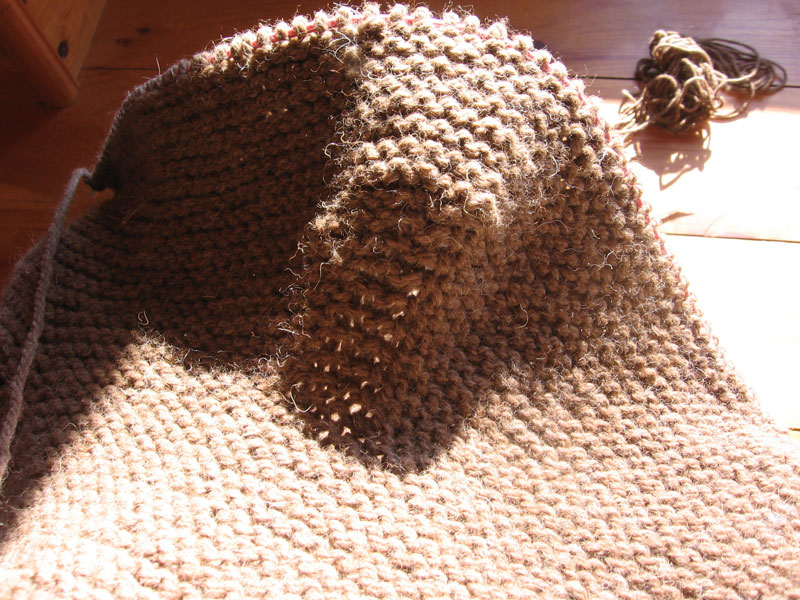
But for now, I am going finish what I have started and see how it goes, and then if I don’t like it, then rip it. It always helps to see what a project might look like finished, to get ideas about how to adjust it. I guess that I am a big fan of knitting and re-knitting.
75% difference (slippers for warm feet)
January 8, 2010

I have had the idea for a while to make a pair of slippers out of some left over scraps from a blanket that I made my mom a few years ago. I carefully saved all the little balls of yarn in a plastic bin, in my old closet at my mom’s house. I was sick at home yesterday, and made a quick trip over to her house to raid the bin.
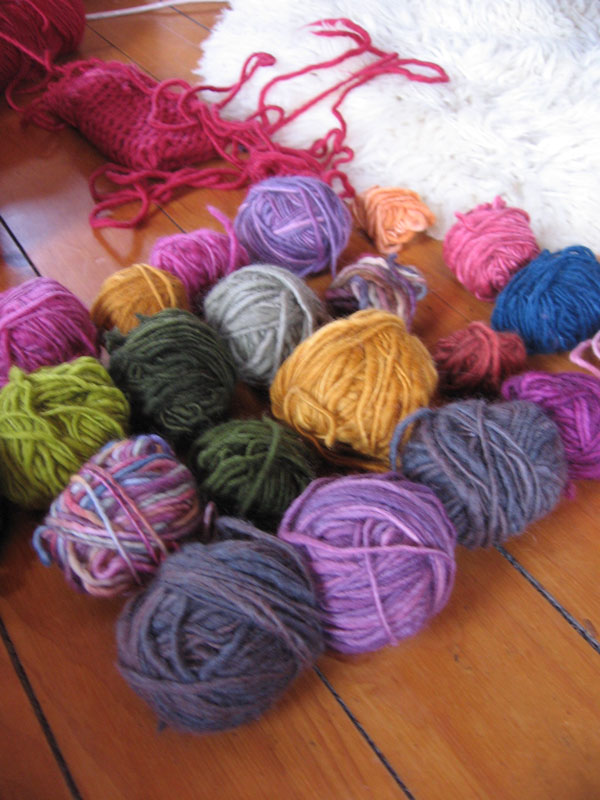
My original idea was to make a pair of sock like inserts that I could then wrap with leather for shoes. However, after making these, I decided that I liked the colors too much to cover, so I will have to make another, less charming pair for my original project…
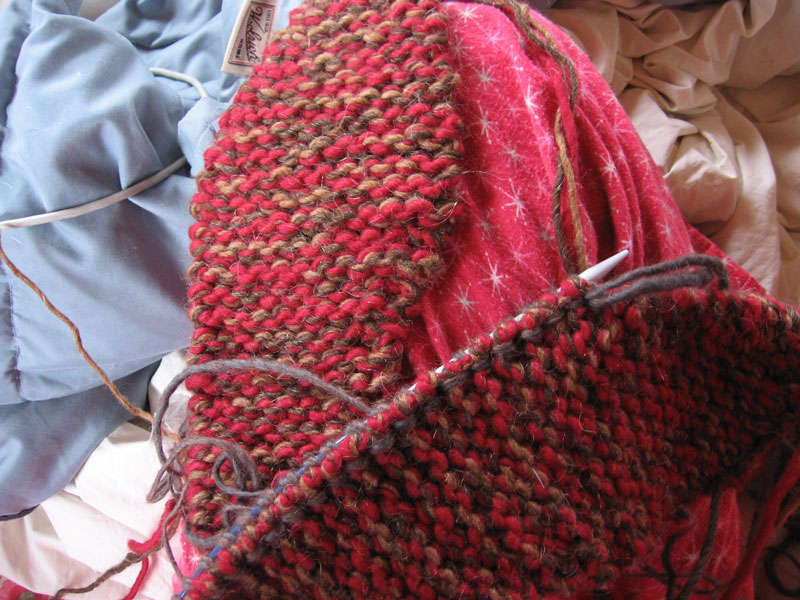
I started with the sole. Made with scraps of of Lambs Pride yarn. Two strands of worsted (different browns), and one strand of bulky (red). The idea for the sole pattern was inspired by a pair of slippers designed by my friend Emmy. I did make a left and right sole though, following the shape of my feet as I knit the pieces.

To make the rest of the slippers, I organized my scraps into even piles. To do this, I used my handy dandy kitchen scale. I weighed each ball of yarn so that the two slippers would be approximately the same (stripewise). All the scraps for the tops of the slippers are from the blanket and are Manos del Uruguay yarns. A beautiful kettle dyed wool, and one of my favorites for felting because of the beautiful texture it produces once felted.

I picked up and knit the stitches around the base of the slipper, and then worked across the top, decreasing to shape for the top of the foot and instep. It took a bit of trial and error on the first slipper, and then I just needed to remember what I did for the second…there might be a few discrepancies.
Above are the slippers resting on the blanket that I made. (borrowed from my mom, with permission of course!)
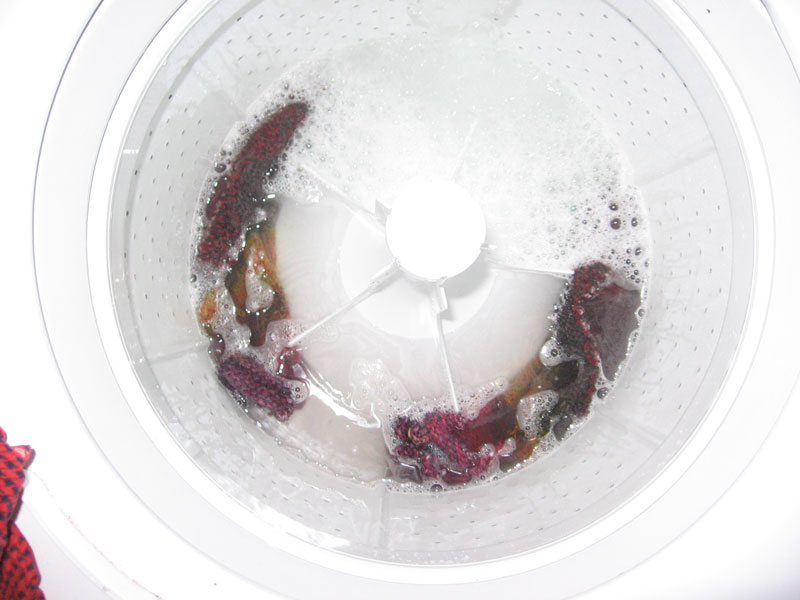
Aaaand wash!
I popped the slippers into my top loading washer, on high heat, high agitation wash for about 10-12 minutes. I didn’t want them to be too felted, but I wanted there to be enough felting so that the slippers were sturdy and durable. The soles didn’t felt as much as the tops, but since I knit them more densely to begin with they worked out okay.

It is important to try the newly felted (and consequently soggy) slipper on before it dries. I like to make sure that the basic shape that I want is established, so the fibers dry as I would like.
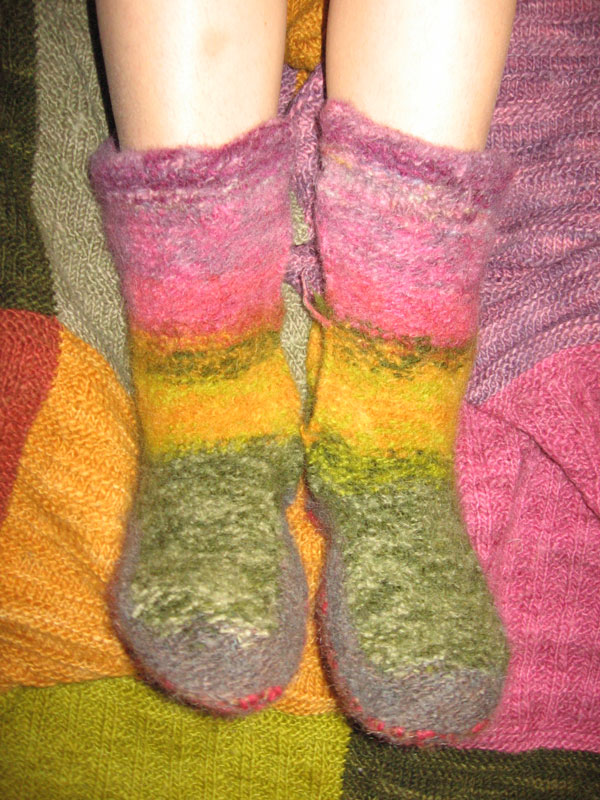
I decided to have the slipper have a slit all the way up the inside. I am not sure if I will put a zipper or buttons, or simply sew it up… so many possibilities!
toasty fingers (or the rest of the hand anyway..)
January 5, 2010
 About 5 years ago I made a pair of fingerless mitts, adapted from the pattern in Weekend Knitting, by Melanie Falick (one of my favorite knitting books). I knit them with Limbo super wash wool, and wore them all the time. I mean every day, or every other day throughout the winter. They are the most handy things to have if you are ever knitting, playing music, typing, or doing anything that requires the use of fingers in a cold environment. Last winter I dropped one of my mitts in to the wood stove, and decided that I might finally need a new pair. Of course that was last winter… I have continued to wear the same pair, one mitt shredding apart for this fall and winter. Last week I gave the remaining in tact mitt to a friend. Now it was really time to make a new pair! Today I had a little time off, and as it was really really cold outside, I spent a good amount of the day curled up by the fire, knitting. Oh how cliche…
After careful consideration, I was able to write the exact pattern for my mitts. (Because I had them for so long, I was rather attached to the exact design.) The mitts are knit back and forth on straight needles, using short rows to shape for the hand. It is a very simple pattern, with a bind off/cast on hole for the thumb, and a three needle bind off.
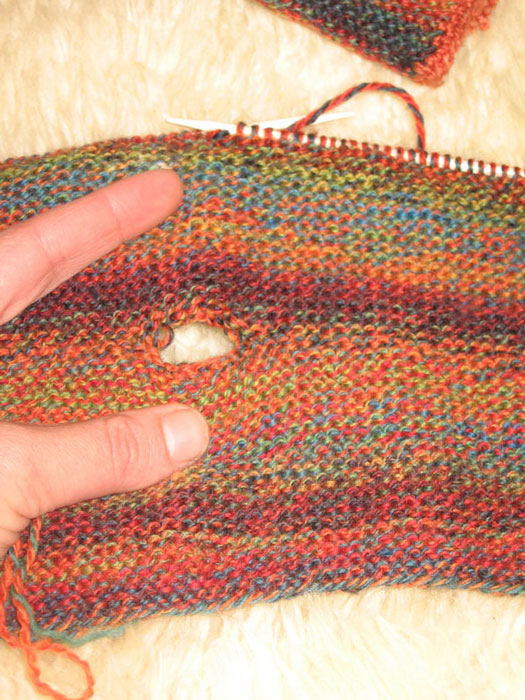
I added a row of single crochet at the top, and around the thumb, and two rows of single crochet at the wrist edge. I knit the sport weight yarn on a size 4 needle to give the finished product a firm, slightly dense feel. The tighter gauge helps the material hold up to lots of use.

 living in the woods and making stuff