two more socks at once (this time on double points)
February 18, 2010
More socks…I just started another pair of two socks at once on one set of double point needles. One sock is knit with the yarn held in the left hand, and the other sock is purled with the yarn held in the right hand. The pattern is in an Piecework Magazine, and has been recently re-released in their single issue magazine Knitting Traditions, which is awesome! My favorite bit about this particular pattern is that it has been referenced in many old knitting magazines as well as in War and Peace! That was all it took to get me inspired! That and the possibility to do something new and tricky, involving socks.
Maybe too tricky…

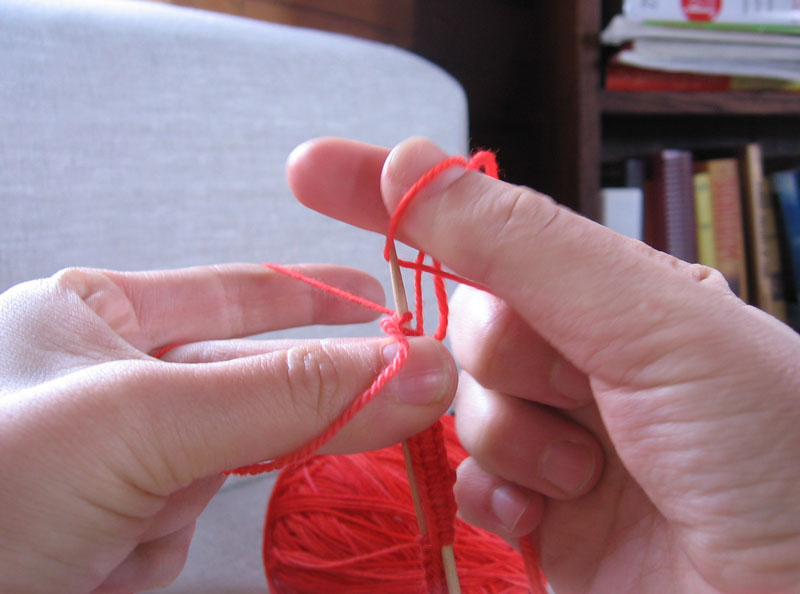

I cast on for both socks at the same time, using my right hand and left hand mirroring each other to cast on.

The right sides of the cast on edge were on the outside, and the wrong sides were together, so I had to twist the stitches so that they were opposite, as the socks are knit with the right sides together. I got through the cast on and knit 2 purl 2 ribbed border with several mishaps, and learned to make sure and check my work REGULARLY so as not to accidentally connect the two socks…

The purled sock is a little bigger, and I am worried that my gauge is significantly different from knitting continentally to purling English style. I am going to keep on working on it for a while and see what I can do…
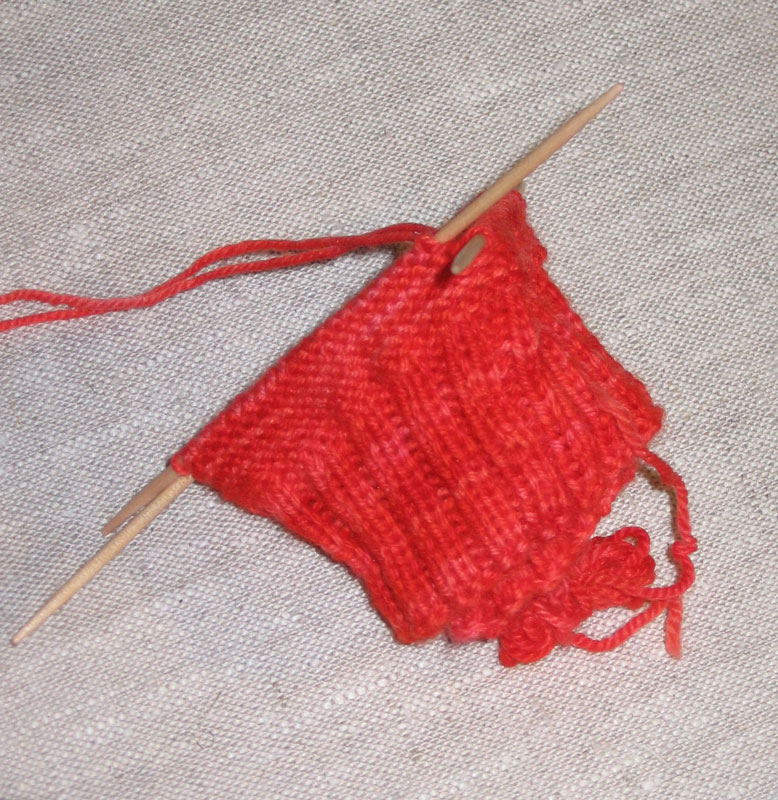
Fast forward a few days..
I ripped out socks numbered one and two, as I am pretty sure that I would have had two distinctly different sized socks if I had continued. The purled sock (on the outside), worked with the yarn in my right hand, was coming out much larger.

I also decided that I would like the socks to be ribbed the whole way down. This means that I would have had to constantly be switching between socks, as well as stitches, which is tricky! It didn’t make sense for me to spend that much time tinkering with this particular project. I ripped out the socks, and switched to one sock at a time.

I finished one very orange sock, measured the amount of yarn that I had left, and re-knit the top and grafted the new part onto the old. There is a bit of a line where I grafted the two parts together, but this way I can use all of the yarn in the ball, and have super long ribbed socks. They come about 2/3 of the way up my calf!

Of course I have one finished sock, and one sock 1″ of the way finished…
I haven’t given up on the two socks at once on one set of double points. I am going to try again, this time using a multicolored yarn, and work really hard to keep my purl stitches tight. Will post when I do!
dosa brunch (with heli in michigan)
February 15, 2010
Heli and I made dosas this morning. She has been wanting to make them for a while, so when I came up to visit, I brought a huge jar of urad dal from my mom. It is a type of “peeled” dal.
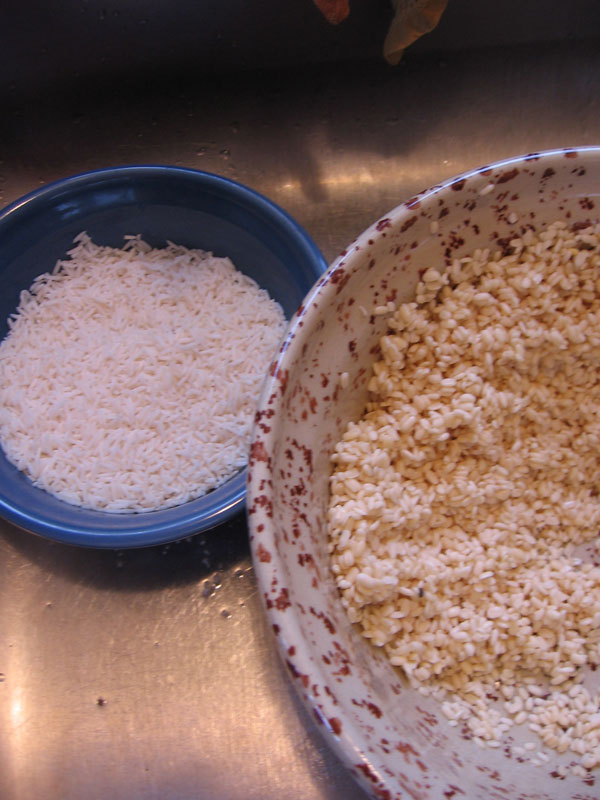
Last night we soaked a cup of dal and a cup of rice in separate dishes. First thing this morning we ground the rice and dal.

After they were ground (the dal more finely than the rice), we mixed them together and set them out to ferment for an hour.

Meanwhile, we got the potatoes started. (For the masala part of the dish…)

We boiled potatoes, and then added them to a mixture of oil, onions, spices, and hot pepper. While they cooked, we started working on the dosas.

Heli and I have never made dosas before. Just a disclaimer. So we didn’t have our hopes set too high for the success of our “paper-thin” rice and dal pancakes. Attempt one below…

Ok…so we thinned the batter considerably, tried different utensils, switched to silicone, and then back to the stainless steel, played around with the heat until we found the optimal temperature and when we were suitably satisfied with the cooking conditions, we had made enough dosas…
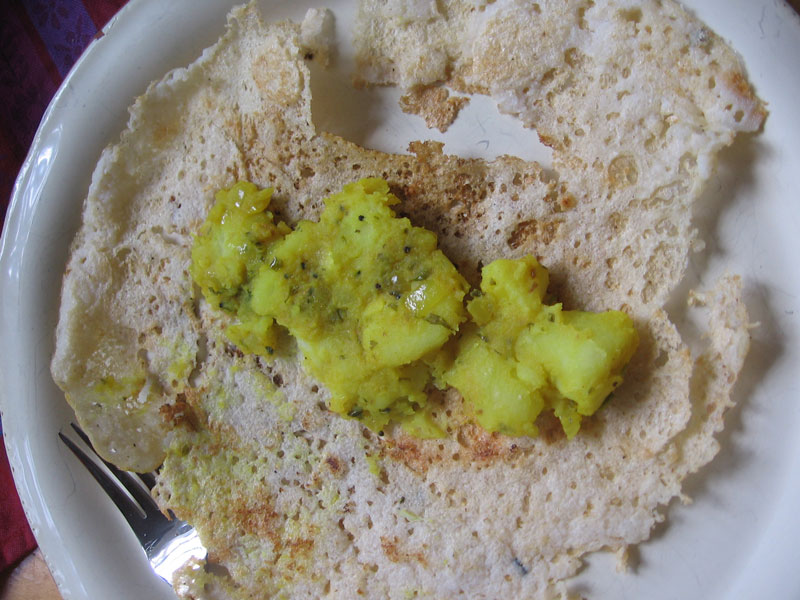
So We had masala dosas, but more like potatoes wrapped in nice little scraps of dough. They tasted good though!

A finished dosa with potatoes, cucumber carrot raita, and home-made lemon pickle.
two socks at once (on one very long circular needle)
February 14, 2010
Sometimes I like to make two socks at the same time. There are benefits and drawbacks, but overall, I enjoy the process and it seems to keep me entertained. Back to the Valentines day theme (I love a holiday that involves pink, red, orange..), I was feeling inspired to make another pair of pinkish socks. And this was a yarn that I haven’t seen worked up. It is a trekking yarn, made in Germany by Skacel, and this particular variety is 80% wool, 20% bamboo (or something like that). I haven’t made socks with bamboo yet, and I love trekking yarns, so thought this might be fun. We only ordered one bag of this yarn for the store and I couldn’t help myself!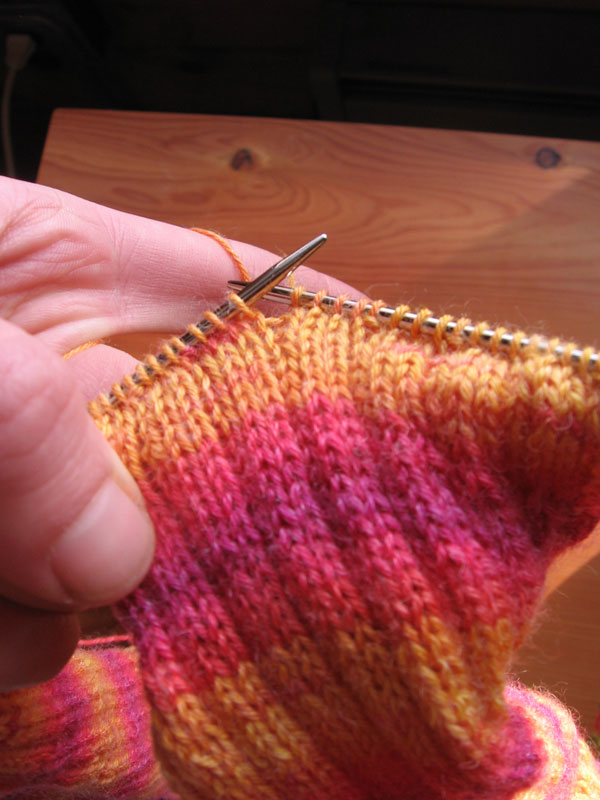
Knitting two socks at once feels like it takes a little longer. Sometimes it seems like the process takes twice as long, as each sock is knit on every round. But at the end, both socks are finished! Kind of a Big Deal! (seriously..) I set up my socks so that the yarn is coming from the inside of the ball for sock number one, and from the outside of the ball for sock number two. Sometimes this involves snipping and weighing the yarn, but in this case I made the socks reverse, and didn’t bother to adjust where they started. Its fun to be random on where the self striping yarn starts. (Its also fun to be selective.)

The socks are cast on, one at a time, and then knit, one row on sock one, one row on sock two. I am working the heels, first the flaps, one row on each. The heel is turned, one sock at a time. For picking up and knitting the gusset, the socks are then worked one round sock one, one round sock two. The gusset always feels like it takes forever for me. And when there are two socks at once thing, it takes forever times two. After the heel is all the way turned, I usually feel like I am home free. The rest of the foot and toe work up quite quickly, and as a project nears the end it seems to pick up speed as well. (Maybe some sort of terminal velocity thing…)
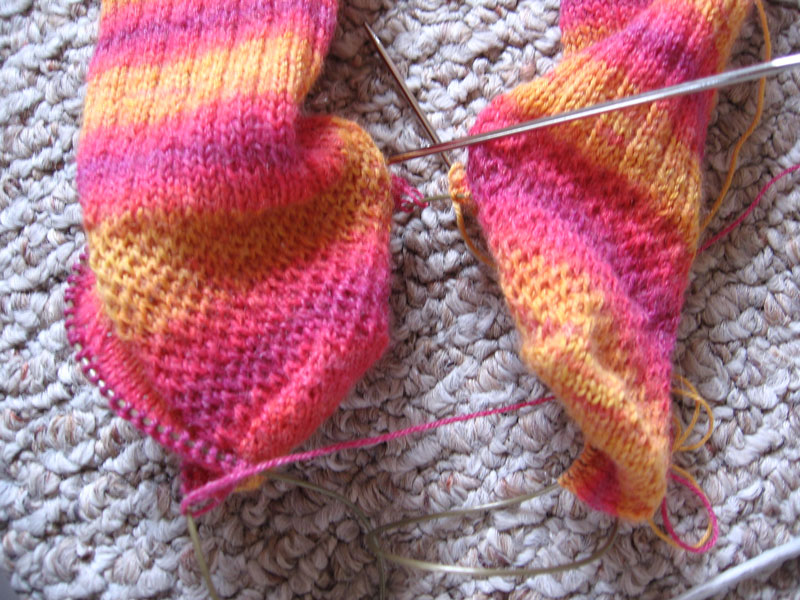
And so, knitting two socks at once does sometimes save me in the end. I have two socks, instead of one lingering sock, sadly waiting for its match.
fresh iowa greens in february
February 13, 2010

We are members of a wonderful CSA (Community Supported Agriculture) in Fairfield, and enjoy fresh greens every week. It is one of the things that makes this whole winter thing a little more doable.
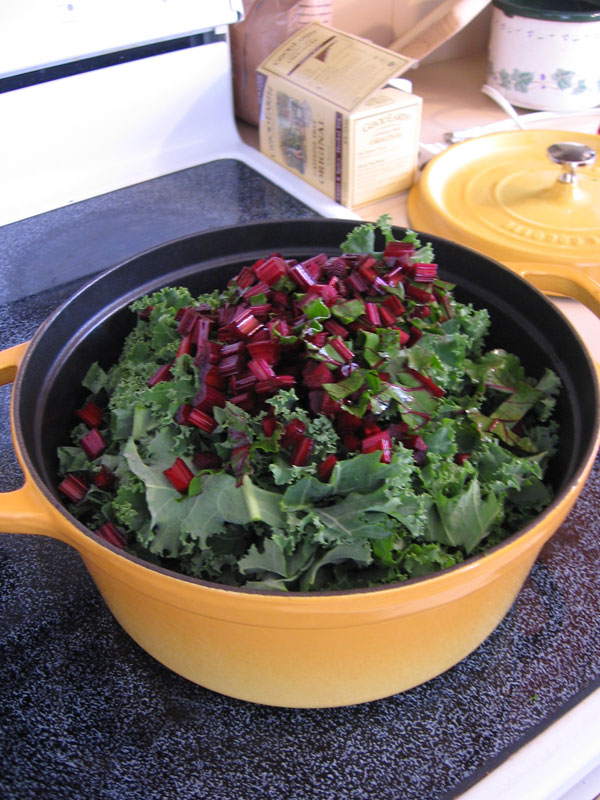
My mom and I get a box every week, and sometimes we have a little trouble eating anything…everything is just so beautiful and fresh, and we want to save it! (She often nibbles a little, but wants to save some for me, and we don’t always getting around to cooking or eating together.) Kind of silly, but oh well.
So this morning, as we were baking cookies, I dug through the fridge and found a few gems that we had not eaten. My mom came up with the idea to make a little casserole. She is such an inspired cook. You could probably give her a basket of vegetables, and she would turn whatever she was given into something fresh and delicious!

The base for the casserole is steamed greens: chard, kale, beet stems, and spinach. She placed the steamed greens into several baking dishes, drizzled with olive oil. On top of the greens she put mashed potatoes (cooked quickly in the pressure cooker), and finished the top with grated prairie breeze cheese (from Milton, IA).

It was a quick delicious casserole, fresh with the greens, but hearty with the potatoes (made with organic sour cream) and cheese.
To go with the casserole, she made a salad of lettuce, and ridiculously fresh arugula, topped with avocado, grapefruit sections, and carrot ribbons. YUM!
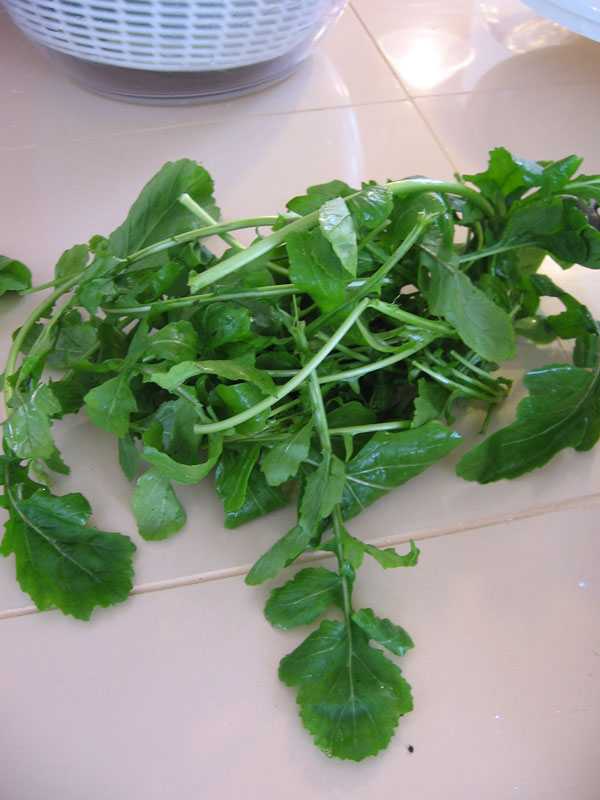
So if you ever find yourself with a produce drawer filled with yummy greens, this is a great meal to use them up and really ENJOY them. Thanks to my mom, of course!

valentine hearts
February 13, 2010

My mom and I made these this morning. She has been making these for Valentines Day for as long as I can remember. The cookies are sweet, but not too sweet, because of the chopped almonds. The pink frosting with almond extract is delicious. And the fresh taste of raspberry jam in the center completes them. This actually might be my favorite cookie. There is something about making a cookie once a year that makes it extra special. I like to make these and pass them out to friends on Valentines day.
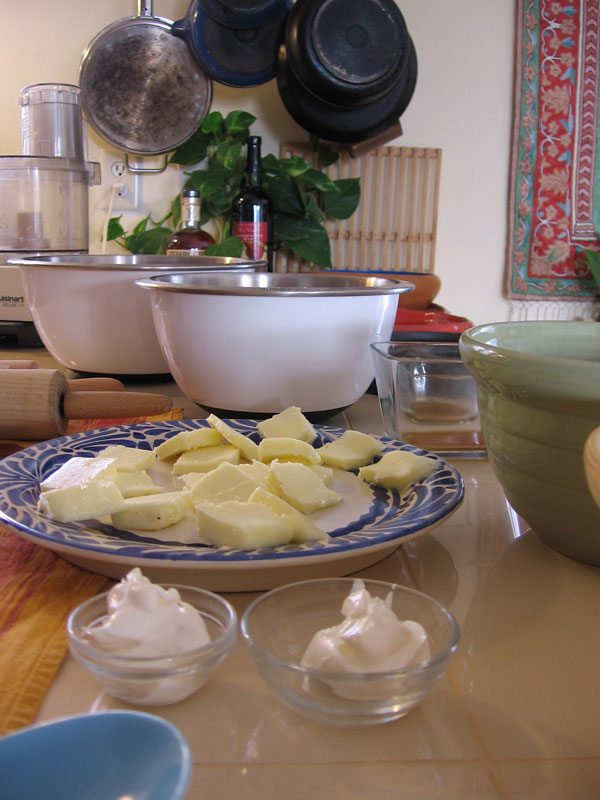
When I made it over to my mom’s house this morning, she had all the ingredients measured out, cooking show style.
The cookie dough is a simple mixture of the usuals. Butter, flour, nuts, sugar, etc. I like to make assorted sizes (we got carried away and only made one size this year..), but nothing too big as the cookies are double layered. Too big and there is just too much cookie.

We first chopped the nuts, rather coarsely in the food processor. Then we creamed butter and sugar, added vanilla and sour cream (egg replacement), and finally the flour. The dough is rather dry and crumbly, but you don’t want it too moist, or it will turn a little cake like and the cookies won’t be as crisp.

My mom rolled all the cookies out.

She was really good at jiggling the dough with the spatula to separate the cookies from the surrounding dough.

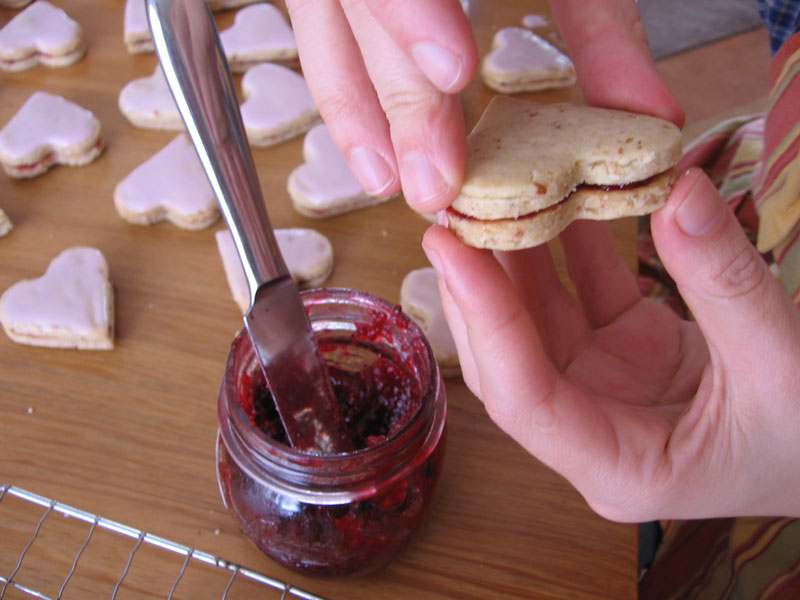
Once the cookies were cooled, it was time to spread them with jam, and make little cookie sandwiches. I saved a jar of homemade raspberry jam that I made this fall for the center layer. I put on just enough to make the cookies stick, making sure that nothing dripped down the sides of the cookies.

It is important to jam the undersides of the cookies together. They stick better that way, and then the outside of the cookies look better too!
The icing is made with powdered sugar (we used the natural stuff, even though it is a little more “home-made” looking), almond extract and vanilla. To give it color, we chopped up some beet stems and boiled them for a few minutes in water. Then we added the colored water to the icing, adding a little extra powdered sugar to stiffen it up.

The icing is carefully applied to the top of the cookie with the back of a spoon (another trick I learned from my mom…).

The whole jam and frosting part took for ever!
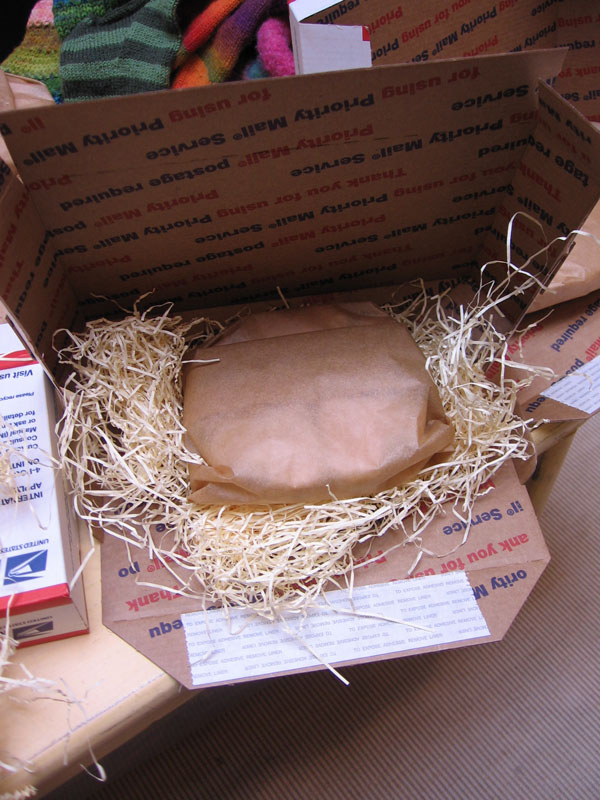
And always, last step is to wrap the cookies up in parchment paper packages. This particular grouping is ready to go to the post office!
kimchee (finished)!
February 11, 2010
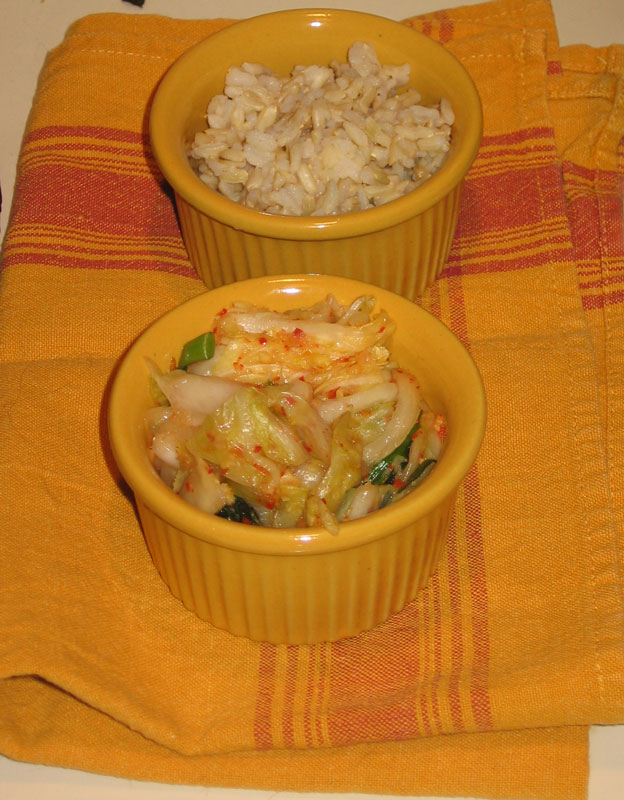
Quick update.
I opened my jar of kimchee today. According to my recipe it said 3-6 days sitting, depending on how sour you like it. A much quicker turn around time than its Western counterpart (sauerkraut)! I was kind of excited to try the finished product, so I called it finished after 3 days. And to be honest, it doesn’t change much in color, and seems to mellow somewhat in flavor. Actually, mellow isn’t really the right word. Maybe more like the flavors come together. My kimchee ended up very spicy, very garlicy, and full of ginger! A perfect combination to keep healthy in this cold weather.
It is really spicy though, and Heli suggested for me to eat the kimchee with a fried egg or rice to cut the heat. (definitely helps!) I am really excited to try making a batch of kimchee with some other greens, such as bok choy, more kale, and other assorted items that I get from my CSA share.
center pull ball
February 9, 2010

My mom taught me how to make these. There are times that you need a ball of yarn that can be pulled from both the inside and outside. I really like to wind my balls of yarn by hand, and this particular technique makes it possible to have both a hand wound, and center pull ball!

Start by taking off the ties that bind the hank. It is important to take care not to tangle the ball of yarn, as this can quickly turn into a disaster. (Never knit from an unwound hank of yarn!!)

I lay the yarn on the floor, sometimes on the back of a chair, or over my toes, to keep the threads straight.

The yarn is wound around the thumb. I hold the inside tail with my fingers so that it doesn’t get lost, and start winding around first the thumb and one finger, and then add more fingers as I go.

It is really important to keep the ball soft, not super tight. I find that wrapping the yarn around my fingers and then slipping them out every few wraps to work well for this.

As the ball gets bigger, I wrap around more fingers, to keep the tension of the ball even. If the ball is too tight, it could result in stretching the yarn, which can result in altering the tension of the finished product.
I keep rotating the ball every 10 or so wraps. This is to keep the structure and integrity of the ball. If you wrap too many times in one place, the ball can come apart more easily. It is better to do fewer wraps, and rotate a little each time (kind of like a machine made ball).

After a while the thumb begins to dissappear. This isn’t a problem, just as long as you keep the base of the thumb defined..

I eventually end up wrapping 3 or 4 of my fingers under the yarn as I go.
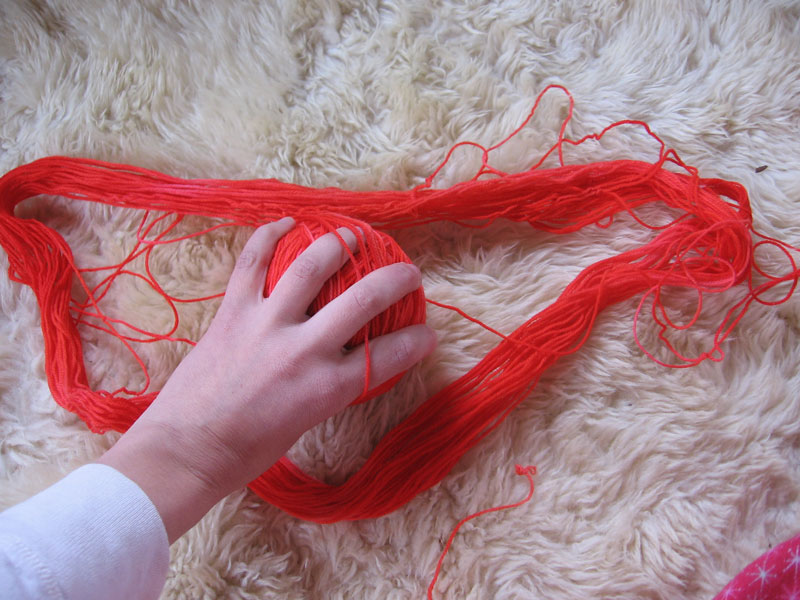
It is always fun to watch the ball get larger as the hank of yarn shrinks. It is especially important to make sure that the hank does not become tangled towards the end. (It is tricky to untangle yarn with a large ball of yarn attached to your thumb too…)
kimchee!
February 8, 2010

Here is my first attempt to make kimchee.
I found a recipe for kimchee in The Joy of Pickling, by Linda Ziedrich. My kimchee is a simple mixture of napa cabbage, a little bit of kale, ground hot pepper, slivered green onions, and lots of garlic and ginger. The whole mixture sits in brine for several days, until the desired sourness is obtained…

Step one is to chop and brine the cabbage overnight. So last night, I chopped my cabbage according to directions, into 2″ squares. I placed the chopped cabbage in a bowl, covered it with salt water, and placed a plate on top to keep the cabbage submerged.
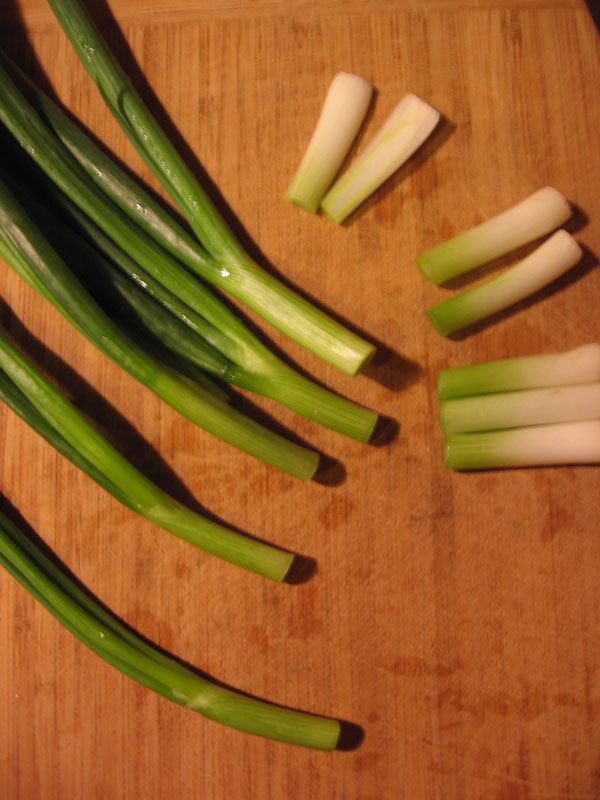
This afternoon, I added the additional ingredients to the chopped and drained cabbage. Slivers of green onions, lots of garlic…

…coarsely grated and chopped ginger. I couldn’t find my smaller grater, but the chopping seemed to get most of the big bits out. I added a little extra ginger to the recipe, as I love it, especially in the winter!
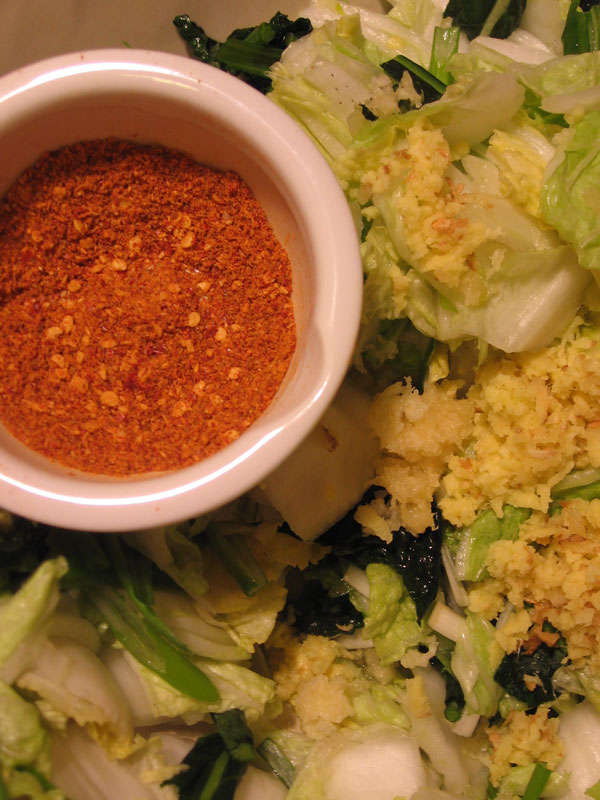
I was excited to use the dried peppers that I put up last summer. In the summer I always seem to acquire more fresh hot peppers than I know what to do with. As a result, I usually end up with more dried peppers than I know what to do with. This was a perfect use for some of my lovely dried peppers. I did have to grind them into a powder, which was a little difficult, with their spiciness…
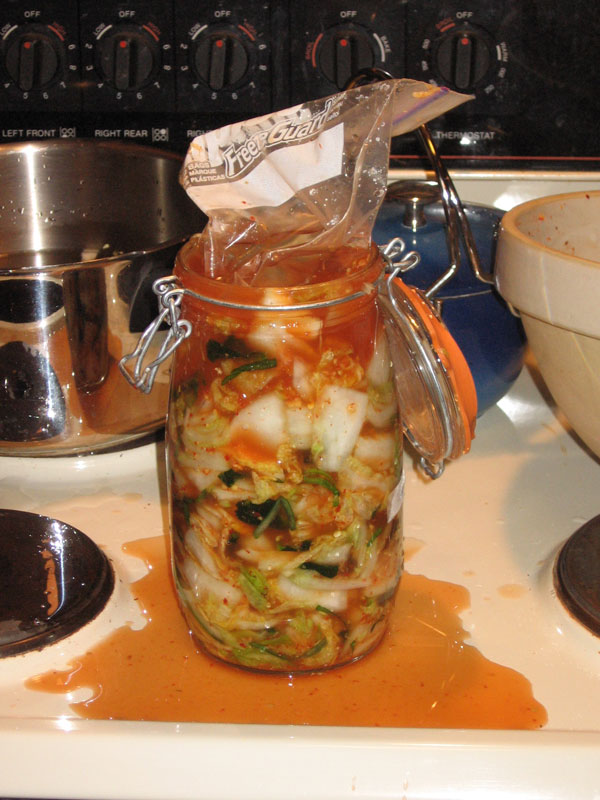
I placed the cabbage mixture into a glass jar, with a plastic bag filled with brine solution on top. Looks like I put a little too much brine into the actual kimchee…
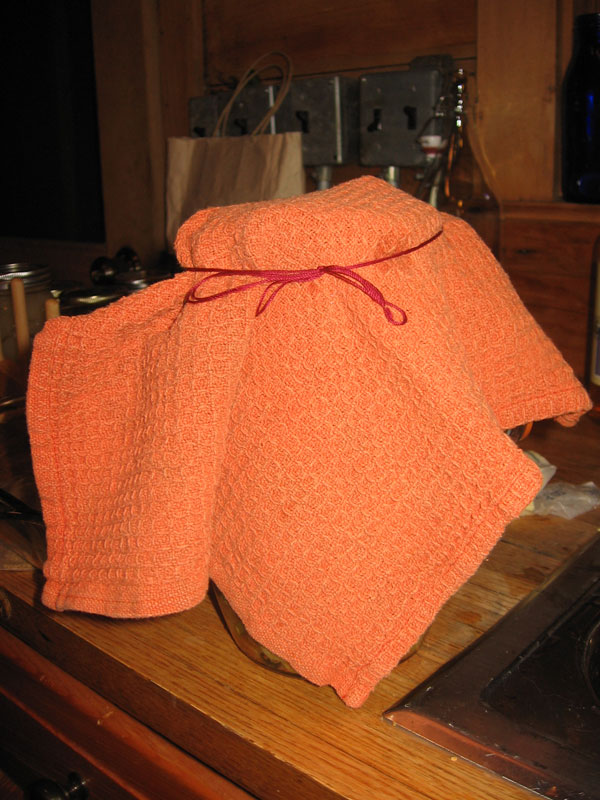
Here is the jar, all tidied up and ready to ferment in a cool corner of my house (not a problem, as I have many).
swatch hat
February 7, 2010
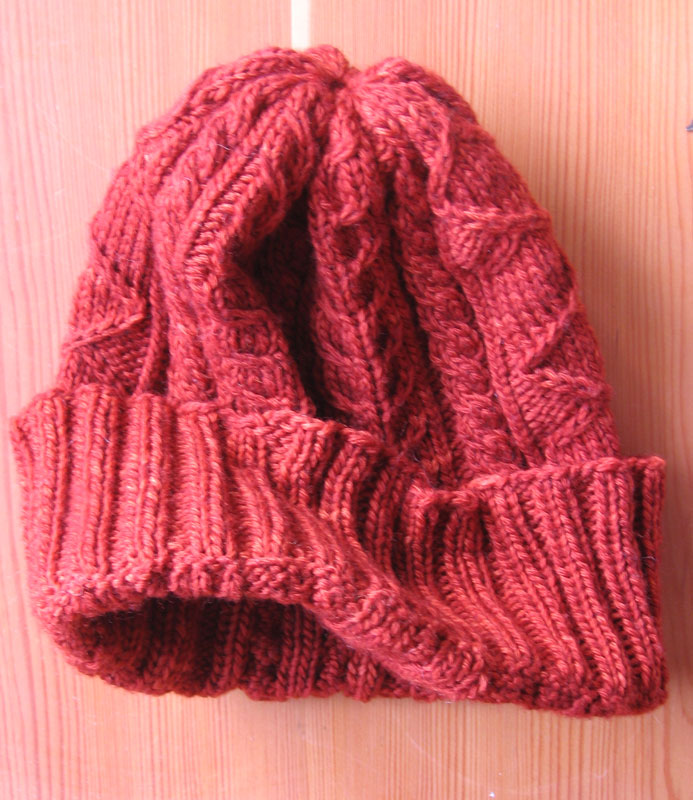
I have had a bag of sport weight Koigu yarn squirreled away on the hold shelf at the store for a while, thinking that I would use it for a sweater. The color is a beautiful, deep, rusty orange (hard to photograph…), and I just love it. When my friend Emmy suggested that we make a saddle shouldered cable sweater, designed by Elizabeth Zimmerman (and her daughter Meg too?), this yarn immediately popped into my head. The pattern is a loose description for how to make the sweater, and it is strongly suggested that you knit a large gauge swatch. She even suggests knitting a gauge hat, or tube, knit in the round as the sweater is, to more accurately measure the gauge. Good plan! I had a sneaking suspicion that the yarn, even thought I loved it, wasn’t my color. Turns out the hat is perfect for my mom. So I am now shopping for a new yarn, and my mom has a new hat!

The hat is made from a combination of cable patterns, including sheepsfold and herringbone. To set off the cables, I added several purls, twisted knits, and a 2 by 2 cable. The additions to the larger cables also work to adjust the size of the finished sweater.

I knit the tube swatch on size 6, 24″ circular needles. It was a little tight working on the 24″ needles for a hat, but I wanted to use the actual needle size and length that I would use for the sweater. (16″ circular needles often have shorter needles, and I was worried that this might change my knitting.)
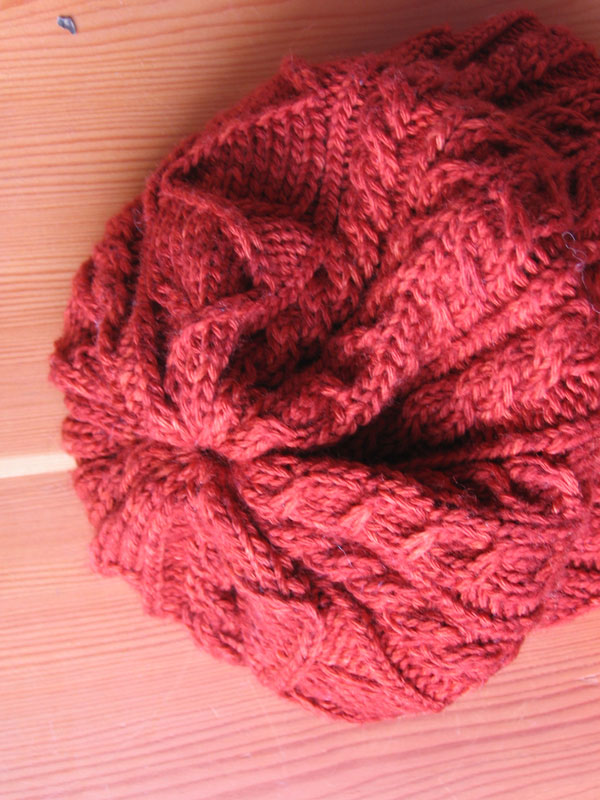
To close the top of the hat, I decreased dramatically over the last few rows, and threaded the final stitches through a sewing needle and pulled tight. There is still a little hole in the top of the hat, but hopefully with a little blocking it can be disguised.

At the bottom edge of the hat I picked up 90% of the stitches (9 out of every 10). I worked a knit 2 purl 2 rib over these stitches until I ran out of yarn.
Overall, the hat was a perfect swatch, to figure out how the patterns worked, how the yarn worked, how the color worked, etc. And one finished hat is the result!
hojicha pudding
February 7, 2010

Miles and Nozomi took us to a beautiful Japanese restaurant when we were in New York City last week. One of the highlights of the meal (there were many!) was a cold pudding, flavored with roasted green tea (hojicha). As we were eating the pudding, we discussed about how we could make it, and decided that it must have been made with soy milk, and that it would be nice and healthy.
Not the case. My mom asked the waiter if he could tell her what was in the pudding, and after a few minutes someone came back and told us that in the kitchen it was made with milk, cream, eggs, a little sugar at the end, and of course roasted green tea, or hojicha.
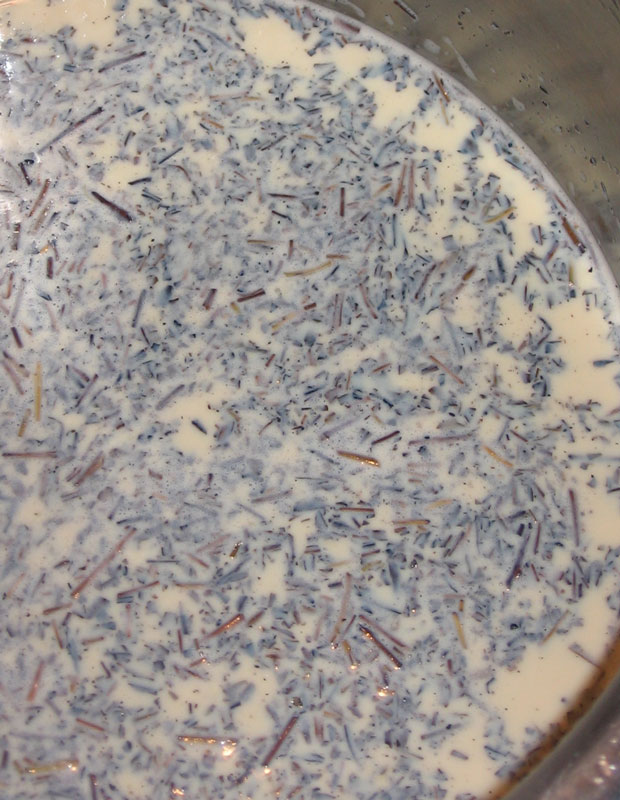
Upon further discussion, we discovered that the tea is steeped in hot milk, which is then added to cream, eggs, and sugar. We jotted everything down on a scrap of paper, and stopped at a Japanese supermarket down the street on the way home and picked up some hojicha.
When I got home from my trip, I was very excited to get started figuring out the recipe. Both Nozomi and I came up with a few similar recipes online, and I tried one today (slightly adjusted) with medium/good results.

The recipe below is very closely based on one that I copied from a website containing lots of green tea recipes.
Hojicha Pudding
Ingredients:
1 3/4 cups milk
2 eggs
2 tablespoons heavy cream
2 tablespoons sugar
15 grams hojicha (toasted green tea)
Preheat oven to 320 degrees.
In a baking dish (I used a glass 9 x 13 casserole dish) place 6 little oven safe ramekins. Set aside.
In a small saucepan, steam milk, remove from heat and add hojicha. Cover with a lid and let tea steep for 5 minutes. Meanwhile, mix eggs in separate bowl and set aside. After 5 minutes, add sugar and cream to milk and tea mixture, and stir until sugar is dissolved. Pour tea mixture slowly into eggs through a strainer, whisking the eggs as you do. At this point, pour mixture through a sieve to remove any little lumps (I forgot this step…). Pour mixture evenly into 6 ramekins, and add hot water to the pan, being careful not to splash water into the ramekins. Place baking dish into oven, and bake for 20-30 minutes, or until done. It is finished when it sets up nicely. I asked my friend Mary and she said pudding should be about like pumpkin pie…
Chill and serve.
I am not completely happy yet with this recipe. For some reason, it seems a bit heavier than the version served at the restaurant, and slightly different. I don’t have a lot of experience with making puddings, so I might have to do a little research to figure out what I need to change.
 living in the woods and making stuff