teeny tiny footwear
December 31, 2009

There is something so enchanting about knitting tiny things. Especially when they are made for cute little feet! The red booties are a project that I finished a little while ago. My friend Jeanne McCanless designed them and published the pattern in Interweave Knits. I had so much fun knitting the little booties!

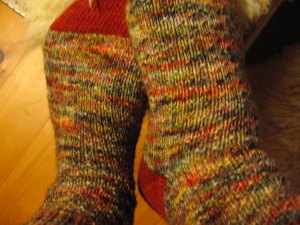
The multi-colored socks are for a friend that is expecting her first child this spring. She doesn’t know if she is going to have a girl or boy, so I found a ball of yarn that was very colorful and cast on. I started by casting on 24 stitches (for some reason I had this number in my head) and after about 5 minutes I realized that I was knitting a sock for my thumb. So I went up to 40 stitches, and that worked well. The yarn is Koigu KPPPM, a worsted weight merino wool that is machine washable. I love love love it for knitting socks, little scarves, etc. It softens with washing, and wears beautifully.
Pattern (I am still not the best pattern writer, so please ask me if you have any questions!!)
I used size 1 1/2 needles, and Koigu KPPPM sock yarn. 1 Skein can make about 2 pairs!
Cast on 40 stitches and work in knit 1 purl 1 ribbing for 5 rows.
Begin Pattern stitch (repeat of 4 stitches and 4 rows)
Row 1: Knit
Row 2: *Knit 3, purl 1, repeat from * across row.
Row 3: Knit
Row 4: *Knit 1, purl 1, knit 2, repeat from * across row.
Continue in pattern for about 20 rows total (5 repeats)
Work heel, as for a traditional heel, maintaining pattern stitch across instep stitches.
Work about 13 rows after final instep decrease, maintaining pattern stitch across top of foot (instep).
Toe decrease, as follows:
Decrease Round:
Needle 1: (second half of what used to be heel stitches) Knit to 3 stitchess before end of needle, knit 2 together, knit 1. Needle 2: (instep stitches) Knit 1, ssk, knit to 3 stitches before end of needle, knit 2 together, knit 1. Needle 3: (first half of what used to be the heel stitches) Knit 1, ssk, knit to end of needle.
Decrease on 1st, 3rd, 5th, 7th, and every following row until 6 stitches remain on each needle. Weave in toe using kitchener stitch.
Weave in all ends (of course I haven’t yet…).

christmas apples
December 23, 2009

This pattern came from my friend Jeanne. She used to have a knitting shop in Oskaloosa, and one of her customers brought it in to her. Not sure where exactly where it came from, but it sure is cute! And a great way to use up scraps. It is quick, easy to finish, and satisfying to knit.
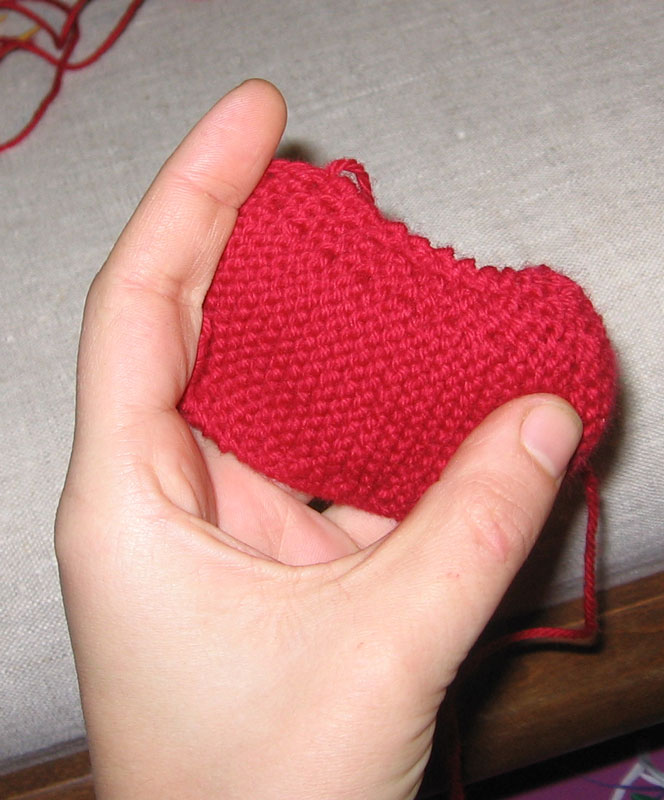
The apples are knit in garter stitch with short row shaping, and sewn up the side. I stuffed mine with colored wool, and then gathered the strings from to and bottom to shape the apple.

I have some sort of ambitious plan to finish 12 of them for Christmas, but am not sure that I will make it. Currently at 8.5 and counting…
Jeanne gave me 4 apples (including the one pictured above) which are hanging on my “tree” along with some unfinished apples as I haven’t gotten to the leaves and stems yet.
The stems are tiny little i-cords, and the leaves are little spots of garter stitch.
Supplies for Knitted Apple Ornament
Yarn scraps in various shades of red, green, brown, or anything else that you might like an apple made out of. And some wool batting (you can also use polyester, but I find that stuffing with wool makes a much nicer feeling object. You will also need a sewing needle and some knitting needles that coordinate with the yarn (a tight gauge is good for this project).
I will post the pattern later today, as I am at home and left it at work…
a mini study in stripes
December 4, 2009
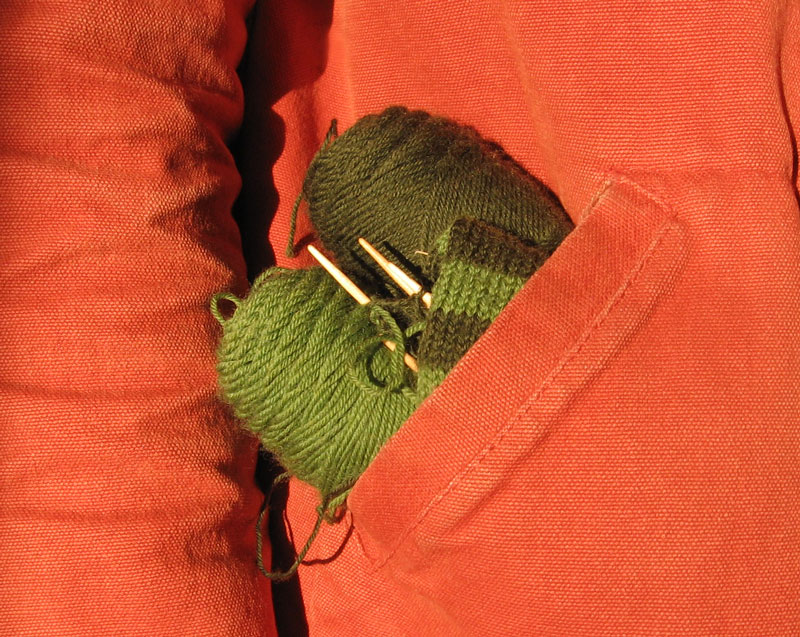
I have really gotten into stripes this fall, particularly when applied to socks. I love to see how colors change when they are stuck boldly next to other colors. Right now I am working on a series of socks, or “Christmas Stockings for the Miser.” They are the perfect size to hold an orange or a hard boiled egg, and a sprig of holly…
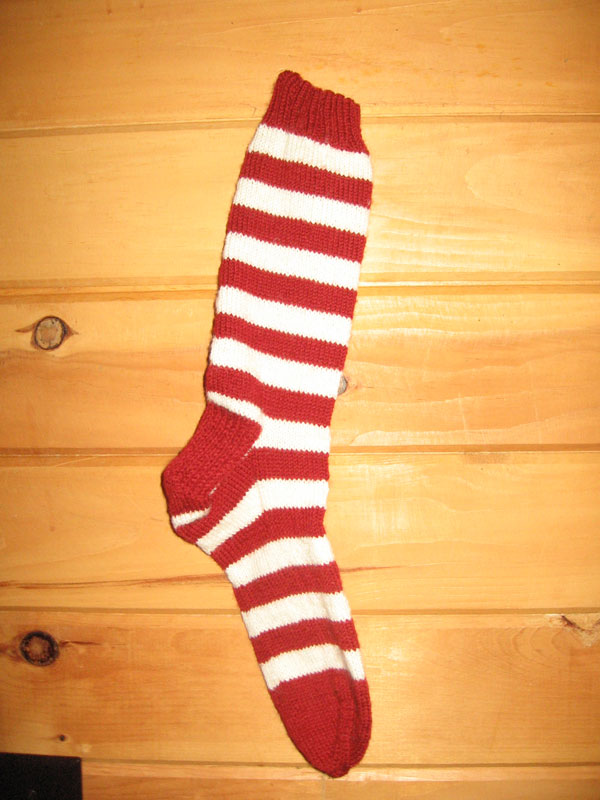
I might put them up in my cabin for my house guests this holiday season. (Makes you want to visit me doesn’t it…?)
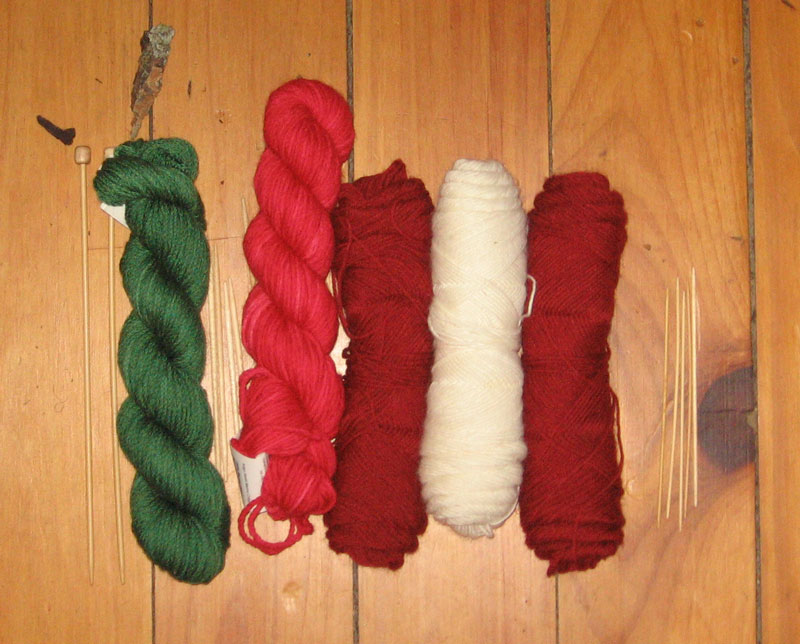
I have found knitting socks to be a great way to test out new patterns. I am currently using socks as a swatch to test the results of color and stripe width mixing. I started off simply, making a red and white striped sock with 8 rows of red, 8 rows of white. Now I am moving onto a dark green and light green sock, making each stripe 6 rows wide. My plan is to make a vairiety of socks, each unique, with different variations on the color themes. I have several balls of red yarn, some greens, and white to work with currently. Maybe I need to throw some non-traditional holiday colors in there for fun, but haven’t gotten that far yet. I also have two balls of sport weight yarn. A red one, and a green one, that when striped could make an exceedingly cute or tacky (depending on how you see it) pair of socks. I have a thought in my mind of a ruffle trim. We will see how much of this project I finish before Christmas (the goal date, so that I have something to hang on my banister, or give my guests to wear on their feet…)
Note on the yarn: the sport weight yarn I am using is Koigu Kersti, and the sock weight yarn is Jawoll, which I am having SO much fun knitting with lately. (The same yarn as the baby booties, which I did somehow manage to finish!)
tomten sleeves
November 26, 2009

My tomten jacket seems to keep on going. I thought that I had the sleeves figured out perfectly, using a short row method to create a bit of a raglan shape. This looked really good on one of the people who was making the jacket in my class, but for some reason it kind of backfired on me. Instead of having a nice shapely shoulder, I ended up with an exaggerated football shoulder, complete with puffiness and shoulderpad like shaping…

OK, maybe it wasn’t really that bad, but it somehow didn’t work for me. So, I decided to go with the original pattern, as written by Elizabeth Zimmerman. Keep the arm heading out perpendicular to the body. Sounds good, right? This time the arm ended up too short. I shaped the arm by decreasing 2 stitches every 3 ridges, as specified in the pattern, but because I changed the yarn weight I ended up finishing the decreases too soon. I thought that it might look ok, but have decided to take the arm back, and make the decreases every 4 ridges.

Right now I have one shoulder pad shoulder and one too short arm and I am hesitating to rip either. The sweater is living on my living room floor, until I get around to ripping the sleeves out and reknitting them.
sunday morning knitting
November 15, 2009
I woke up this morning and settled right down by the fire to knit. There is a lovely little couch, right next to the stove that currently is missing all of its cushions, but does have a sheepskin sitting on it. I got out my two most current knitting projects, and set to work. I am taking two classes at the store, one to make a little lace baby bootie, and the other to make a Tomten Jacket.
Both projects are fun and engaging, with the sweater taking up more brain power, as I am adjusting it as I go to make sure that it will fit well. I am currently working on the sleeves. The pattern, designed by Elizabeth Zimmerman (one of the best knitters EVER) is knit modularly, and while it works really well for a child’s sweater, there are some adjustments that help for the adult version. I made most of it according to the plan, with a few mistakes that I actually like the result of. I was inspired to adjust the sleeves after reading about the version knit by Jared Flood of Brooklyn Tweed.

I have finally settled on working short rows for a while and then working straight, after trying it on several times this morning, and then again in class with lots of helpful comments and views. There are three of us in the class making adult sweaters, and it is really fun to collaborate together, changing and adjusting the pattern to suit our needs.

I spent a lot of time working on the join of the sleeve to the sweater body. In the pattern you are supposed to keep the underarm stitches attached, and then knit two together at the end of each row, thus joining the set in sleeve to the body. I didn’t like the results of doing it this way because the two sleeves were different from the front view and back view. In order to make them the same, I took a technique that I learned from Dolly in a modular knitting class and adjusted it so that I was decreasing on either end of the right side. This was a little tricky to figure out, but the finished result is very similar on both sides of the sleeve. I have been working on writing up the technique, but am not completely finished yet..

The second project, the baby bootie was designed by Jeanne McCanless, of Oskaloosa. Jeanne is another of my favorite knitters! She took the pattern from a baby bootie that someone brought to her and figured it out. The unusual design is fun to knit, and a great tiny project to have along (as opposed to the huge tomten jacket). And it is published in this year’s holiday edition of Interweave Knit Magazine!! We are so excited about this!

The lace is knit in a “T” shape, and then the bottom is picked up and knit in garter stitch. The finished product definitely looks like it was harder to knit than it actually is. It is a perfect gift project. I am making the booties in red, as opposed to the traditional creme, and am loving working with the yarn!! It is Jawoll, a combination of wool and nylon, made is Switzerland, and perfect for socks of all sorts. It comes with a spool of reinforcement yarn for the toes and heels inside the skein! (I am tempted to start a pair of red and white striped socks or legwarmers when I have finished the booties.)
cozy socks
October 27, 2009
About a month ago we got this beautiful yarn in at the store. It is super soft, one ply, and machine washable. Generally one ply yarns (where there is only one strand vs several strands twisted together) don’t hold up for socks as well as multi ply yarns, but I still wanted to make a pair of socks out of the yarn. They are more of “treat” socks, meant to be worn specially, and not expected to hold up to lots of wear and tear.
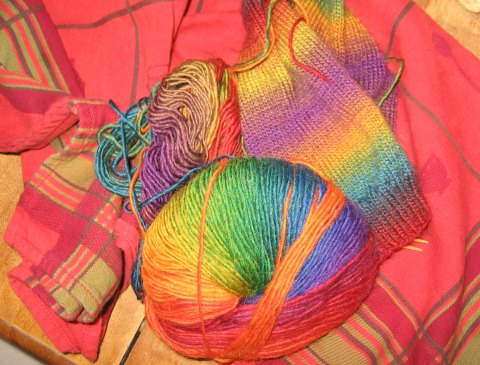
I started the socks with my usual 60 stitches on size 1 1/2 needles. I got a few inches down the leg and realized that this would definitely not fit me! The yarn ended up working up much tighter and smaller than I expected. I ripped the sock out and cast on 72 stitches. I decided that since this was a luxury sock, I could afford to have a little slouch in it.
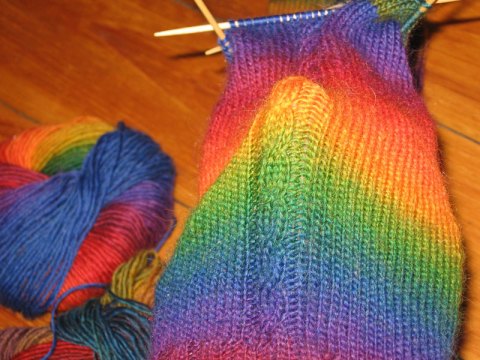
Just to take it in a little, and to add some vertical integration to all the horizontal striping, I added a cable down the side. The cable is a simple 2 by 2 cable, crossing over every 6 rows, and bordered by 2 stitches of garter stitch on either side. It always seems to take me a while to figure out when I am supposed to be crossing a cable, so I really worked on figuring it out on this project. With success! I realized that if you pull the knitting directly to the right of the cable stitches tight, you can see the threads of each row. So instead of keeping track of how many rows I had knit, I just would pull the knitting, and count up the 6 threads, or rows. Much easier!!
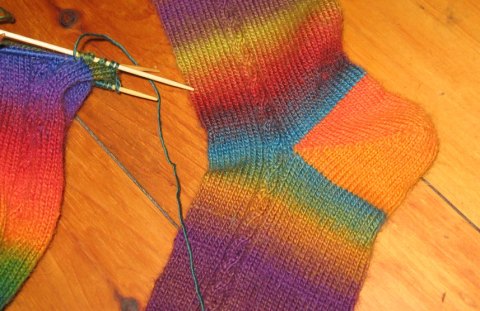
I have been enjoying using the yarn over, or afterthought heel a lot recently. I used it here, switching from one skein of yarn to another. I couldn’t decide which color to use, so I ended up with one colorway for the first sock, and a different colorway for the second. The heels and toes are made with the opposite colors, thus tying the socks together (sort of anyway).

I kept the cable to either side of the heel, in order to have it on the outside of each sock. I really liked how the cable travelled down the sock, so I kept it all the way up to the toe. I did this by decreasing on the inside of the cable, pulling it over from the outside of the foot to the inside, where it ran into the other decrease. It is fun to remember sometimes that the decreases/increases don’t have to be in the exact same spot each time!

And that is it. I have one sock completed, (blocked and all!) and the other at the heel. I am hurrying to finish them, as the days are getting colder, and warm fuzzy socks have an increasingly large appeal…
little blue sweater
October 20, 2009
 This is a sweater that I made up from scratch. I haven’t tried it on anyone yet, so I am not exactly how it will fit, but I think that it should be ok. I am meaning to write a pattern up for it but haven’t yet. Baby sweaters seem to be the way to go for first time designing. For one thing, they are small, so easy and quick to knit, rip out, and reknit. The second plus is that the baby is what most people look at anyway, so the sweater can be a little funny and get away with it!
When I was envisioning this sweater I wanted to see mostly blue, with a little white. The only trick on the sweater was with making the stripes in the right proportions, which ended up being 3 rows blue, 1 row white. I used a circular needle (from my Denise kit) and on the color change rows I simply went back to the beginning of the row after the new color, either knitting or purling two rows in a row. The only place that this caused any problems was in the shaping for the top. Somehow I ended up slipping a few rows back and forth from one needle to the other in order to knit with the right color.
The shaping was really simple. I decreased a good portion of the front and back stitches for the inset sleeves, which was what I wanted. A particularly stated cut into the horizontal stripes. I tried ending the sleeve with white, then blue, and finally decided on the particular composition above. A little white, then a little blue.

There are two buttonholes at the top of the sweater, which I have been debating wether or not to keep. As per usual I still have not attached any buttons, which might be more of a hassle to button up anyway.
I knit the sweater with Limbo yarn on size 5 needles. Knitting with Limbo yarn is always fun! It is 100% machine washable wool, and really really soft. And it wears very well. I had a pair of fingerless gloves made out of Limbo that lasted for years (until I dropped one in the wood stove last winter).
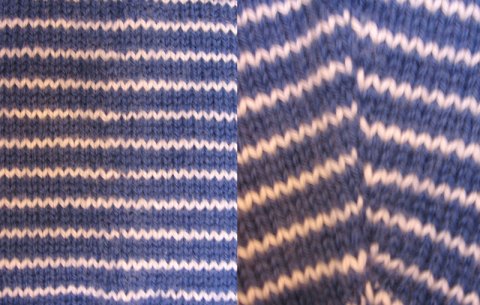
It was definitely tricky to sew up the seams on the sleeves, balancing the increases and keeping the stripes exactly in line. The above photos are of the seam on the side of the sweater (left) and the seam on the underarm (right). I think that if I were to do it again I would have the increases further in from the edge on the arm (they are positioned at one or two sitches in). This would make it easier to sew together. I had to sew up the sleeves several (or more) times in order to get them as I wanted them. The side seams were fine, but sewing the sleeves into the front was a little difficult. I tried to keep a good ratio of stitches to rows (4 rows to every 3 stitches) as I sewed the seam. but it kept on getting mixed up.
monkey socks
September 30, 2009
Monkey Socks
These are inspired by some monkey socks that I used to have. They are made from Koigu KPPPM, a super soft, hand dyed 100% merino wool. I am not much of a pattern writer, so please email me if you have any questions! It is pretty much as basic sock with a short row heel and a rounded toe. You can use your own sock pattern if you want!
monkey socks
September 22, 2009

These are inspired by some monkey socks that I used to have. They are made from Koigu KPPPM, a super soft, hand dyed 100% merino wool. I am attempting to write a pattern for them…will try to post it soon.
 living in the woods and making stuff