finishing and starting
November 17, 2009
Today was a finishing old drinks and starting new drinks day. There is definitely something about drinks tasting really good after sitting for a while… for different reasons of course! I put up some raspberries in vinegar a month or so ago (when there were lots of them to pick). They sat in my pantry, imparting all their flavor into the apple cider vinegar and red wine vinegar that they were soaking in. Today I strained them and made the syrup for a “shrub.”

A shrub is an old fashioned vinegar fruit drink. I have found lots of different recipes and variations, and the recipe that I used was from The Joy of Jams, Jellies, and other Sweet Preserves (as per usual). I strained the raspberries from the vinegar by passing it through a damp cheesecloth, and then I boiled the resulting raspberry vinegar with some sugar. (I am a little concerned that my house will smell strongly of vinegar and raspberries for a while after the boiling process.)

I tried a teaspoon full of the syrup straight, and it nearly made me choke it was so strong. I added the syrup to water, and it turned into delicious, uniquely flavored, zingy drink. It is almost a better drink for warm weather, so I think that I will try to bottle some of they syrup up and save it for the summer…

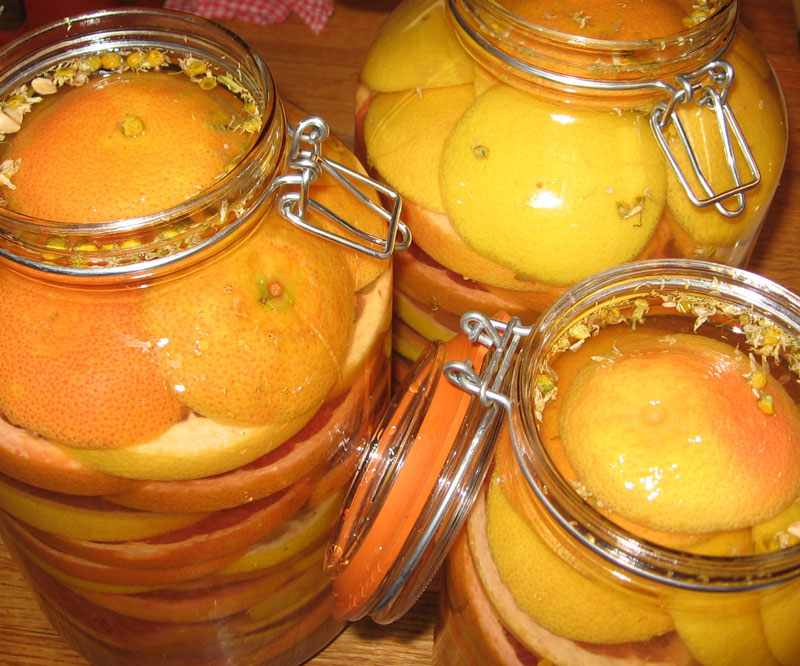
On the other end of things, I started a batch Vin de Pamplemousse (I like to think of it as pamplemousse juice as it rhymes nicely), a recipe from Saving the Season, my favorite blog on canning. The recipe, which takes about 40 days to mature, has been conveniently posted about 40 days before the New Year..

The recipe calls for a whole bunch of grapefruit, sliced and placed in large jars with some vodka, sugar, lemon, chamomile, vanilla, and a whole bunch of white wine. I made a single batch, which filled two 4 liter jars, and one 2 liter jar. The process was really fun, slicing and gently crushing the fruit, and releasing the fragrance of the vanilla, citrus, and chamomile. I am really excited for this (warming) drink to be ready!
canning kraut
November 11, 2009
I came home last monday night to a “matured” crock of sauerkraut. I left it with my mom for this last week, and when I returned, it was a lovely golden color, tart, and crunchy! I started the sauerkraut about 3 1/2 weeks ago, and it sat in my kitchen, periodically scenting the whole house. I had to watch it, making sure that the top remained clean throughout the process of fermentation. Making sauerkraut is much easier than I had initially imagined. It is amazing to me how simple a recipe can be, yet taste so good! Basic sauerkraut is made with salt and cabbage. Thats it!
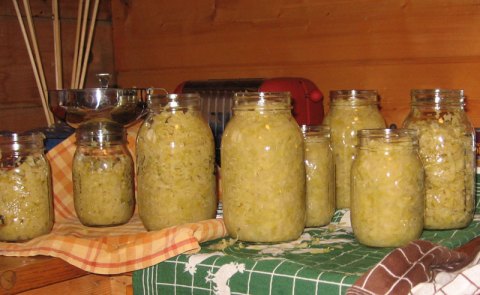
Fully fermented sauerkraut was traditionally placed in a cool location to spend the winter. Now days, around here anyway, it is canned, frozen, or eaten when it is finished. I used a recipe for processing my sauerkraut from The Joy of Pickling. The remaining kraut I have put into jars to hand out to family (and the little left is going to go in the freezer). I know that sometimes freezing is better, but for some reason I really prefer to can things. I guess it has to do with the possibility of a storm leading to a power shortage, leading to frozen goods going bad…
canned pears
October 22, 2009
 There are certain things from my childhood that evoke specific experiences. Canned pears are one of those things. When I was six my family drove out to the desert in southeast Oregon. We drove across country in a converted school bus, and very carefully planned and packed our bus with supplies, including many cans of pears. I remember the smell, texture, and taste of the pears, floating in syrup. I remember eating pears in syrup at dusk, while watching for wild horses in the distance.
When my friend Clint (with the pear tree) gave me another bag full of pears I decided to try canning them in halves, as I remembered. The process of making canned (technically “jarred”) pears is simple. I got the basic directions from the recently revised Joy of Cooking.
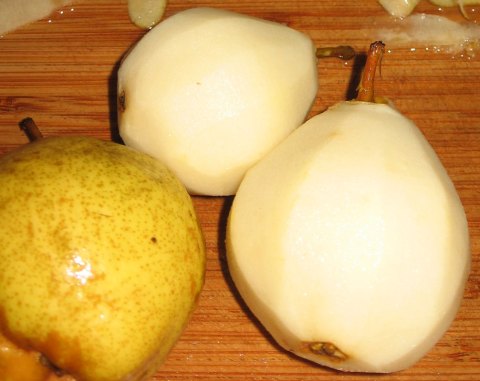
I peeled the pears and put them in an anti browning solution of lemon juice and water.

Meanwhile I made a sugar syrup using approximately 1/2 cup sugar for every quart of water. Joy of Cooking gives guidelines for how much/little sugar should be used, an I went somewhere in the middle, on the less sweet side.
Then after cooking pears, I carefully placed each slice into warm jars and processed according to directions. When I tried fitting the pear halves into the regular pint jars that I had I realized that they wouldn’t really fit. I decided to get some wide mouth jars as well, so now I have some jars with pear quarters and some jars with pear halves.

And thats it! Very simple, and the result I tried for breakfast this morning. The pears were rather firm to start with, so they maintained a nice texture even after cooking and processing in the boiling water bath. I am looking forward to lots of cozy pear treats this fall and winter!
sauerkraut
October 17, 2009
 Today I went to my friend Moni’s house and she showed me how to make sauerkraut! I have been wanting to make sauerkraut for a long time now, and have spent quite a bit of time reading about how to make it, looking at different recipes, and methods, etc. Although it is simple to make, with a basic ratio and set steps, I have been a little shy to try it. But last weekend when I was visiting Heli in Ann Arbor, cabbage was available at the farmer’s market, and I grabbed a few heads to take home. I love cabbage, fresh and fermented, so I figured that I would be able to make use of it even if I didn’t make the kraut. Heli kept telling me that I should call Moni, her friend Daren’s mom, so I did, and not only did she tell me all about how to make sauerkraut, but she had me over this morning, shared cabbage from her garden, and taught me all about how to make sauerkraut. It was so much fun!! We had lots to talk about (she knows all about gardening, canning, and insects, to name a few things), and the process went by very quickly.
Moni has been making sauerkraut the same way her mother taught her. The first step is to prepare the crock (which Moni lent me and is now happily situated in my kitchen). This particular crock is huge!!  The number 5, stamped on the side, indicates that it is 5 gallon crock, which means a lot of cabbage. The crock must be cleaned thoroughly, and fitted with a plate, which will be placed over the cabbage at the end to weigh it down.

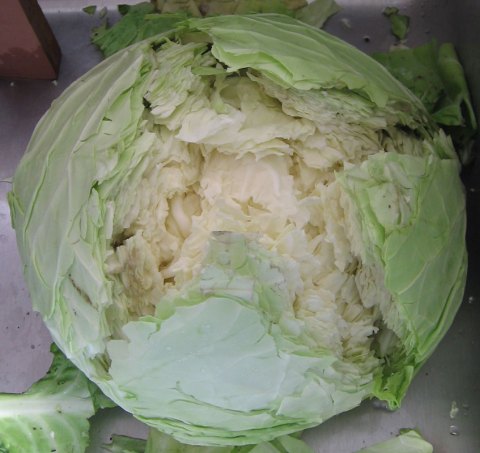
Then the cabbage is cleaned, trimmed, and either thinly sliced or put through a food processor. This year was a very wet year so the cabbage was huge, and some of the heads that we used were even bursting open!
 We both shredded and chopped our cabbage. Then we added the cabbage to the crock, a little bit at a time, mixing it with salt to taste as we went.
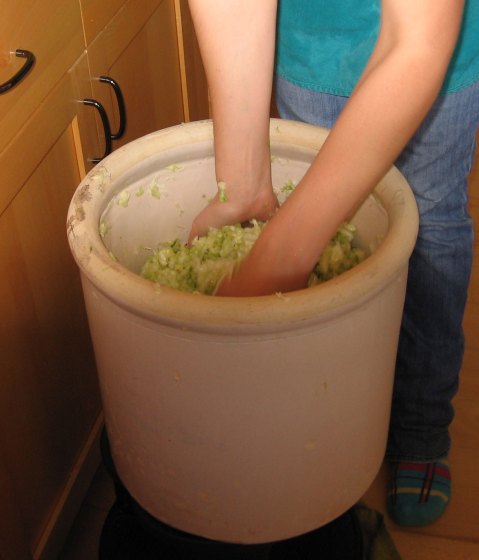
Adding salt to the mixture draws the moisture out of the cabbage, which creates the briny solution that the cabbage ends up “stewing” in. According to Moni, the best time to pick cabbage for sauerkraut is in the morning. The more moisture in the cabbage, the quicker the liquid is released to form the brine.

After all the cabbage was added we mixed the contents of the entire crock to make sure that there was enough salt. We ended up adding more, and as we were remixing, I noticed that liquid was already collecting at the bottom of the crock. By the time I got home with the crock, and added the plate and weighted bottles, the liquid had reached the top of the cabbage.

The plate covering the cabbage is there to keep the bulk of the cabbage submerged in the brine. I placed two clean quart bottles full of water on top of a dinner plate, which fit perfectly inside the crock. On top of all of this I tied a tea towel to protect the contents from any fruit flies or other possible vermin.
Now it is time to wait and let the lactic fermentation take place!!!
I will post more pictures as the sauerkraut develops.
green tomatoes (not fried)
October 15, 2009
Yesterday and today I made some green tomato pickles. I used two different recipes, one that reminded me of my Grampa, and the other because it called for lime (calcium hydroxide) which I have never used. Both recipes are from The Joy of Pickling, by Linda Ziedrich. I started the pickles yesterday (after a trip to the store for lime) as they required an overnight of soaking before they were ready to process. 
Freshly sliced green tomatoes. So many shades of green, marbling in and around seeds and cavities.
Tomato slice soaking in a solution of lime (calcium hydroxide) and water. This process creates much crisper pickles. I soaked the tomatoes overnight, and when I took them out of the solution they were stiff as a board! Quite different from the tomato slices soaking in salt for the curry pickles.

After rinsing and soaking, rinsing and soaking, and rinsing and soaking again, I mixed the lime tomatoes with onions and spices and simmered for a little while, and then I had to stuff them into the jars. The lime made them so stiff that I ended up cutting the big ones in order to fit them in.
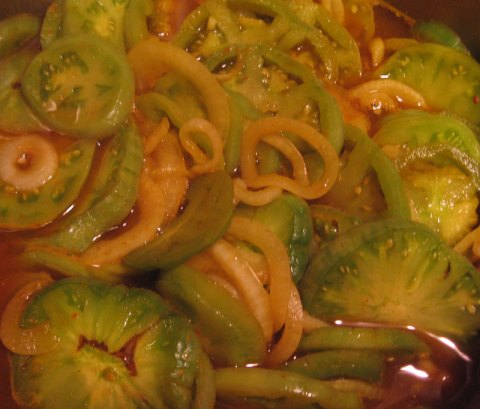
The second pickle was made with curry powder and other spices. I made them because they reminded me of my Grampa, who always seemed to like spicing food with curry powder. The tomatoes for the curry pickle were significantly softer (no lime, just sitting out with salt).

These are the lime pickles after the jars were processed in boiling water. It is always sad to me when fruits and vegetables lose their vibrant color. They have to sit for at least three weeks now until they are ready to eat!
apple picking and processing
October 12, 2009

Heli and I went to an apple orchard yesterday, and picked a lot of apples! Somehow I always end up with more than expected. When we got home we excitedly discussed our options. We both had already made apple butter, but didn’t have any apple sauce, so decided on that. And to spice things up a little we also made some caramel apple jam, with several variations.

When we went to the local plant and garden store this morning (Downtown Home and Garden, which is awesome!), we decided to try some new jars. Usually we use Mason or Bormioli jars, but we fell in love with Weck jars. They have a different sealing system, and glass lids! They are a bit more expensive, but I keep telling myself that I will reuse them for the next 40 years or so, so this is a one-time investment…I will probably always buy new cute jars with this rationale!
When we arrived home, with 5 trays of empty jars, to attack our two mountains of apples we were excited! And now, after canning ALL day, we are rather tired, but all the jars along the windowsills create a nice homey feeling.
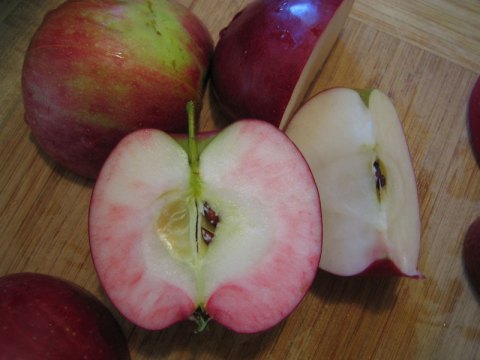
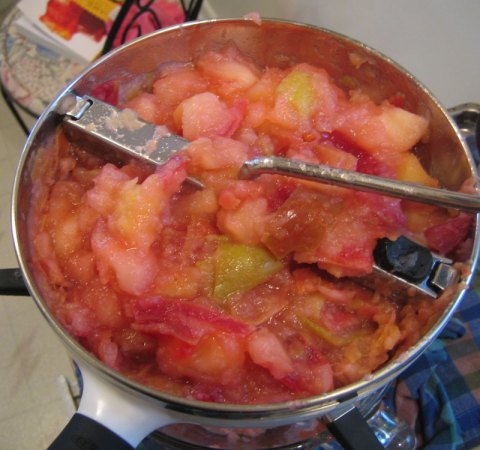
Our first project was caramel apple jam with brandy and vanilla. We had to stop at the liquor store to purchase some brandy, and the grocery store for some cinnamon. The apple jam uses apple sauce, which we made with quartered and cored apples (we kept the peels to add flavor and color). We added a little water to the bottom of the pan so the apples wouldn’t stick, and boiled them until soft, and then put them through a food mill.
 The fun part of this recipe was making the caramel! You don’t stir the mixture of water and sugar as it cooks, and this creates a crunchy, sticky gooey sugar mess that smells wonderful. When we added the apples, everything sizzled and puffed up, and then turned into little pieces of hard sugar mess.
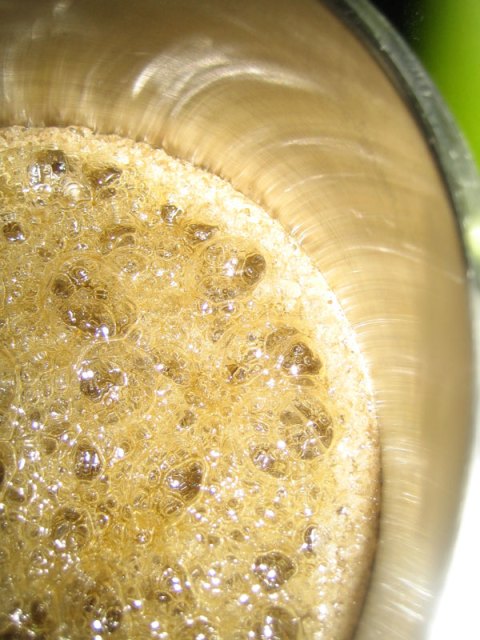
After stirring the apples and sugar for a while we put the mixture into our new jars and sent them off to a hot water bath. Heli’s stove is about the size of a matchbox, so the logistics were a little tricky. We had to juggle all the pots of boiling liquid from burner to burner, but somehow we made it without any massive burns!
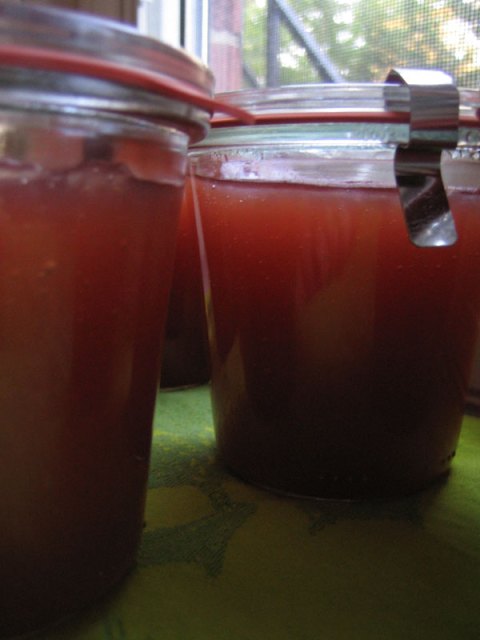
The new jars filled with caramel apple jam! Some with brandy and vanilla, some with vanilla, some with only sugar. And some a mixture of everything all together!
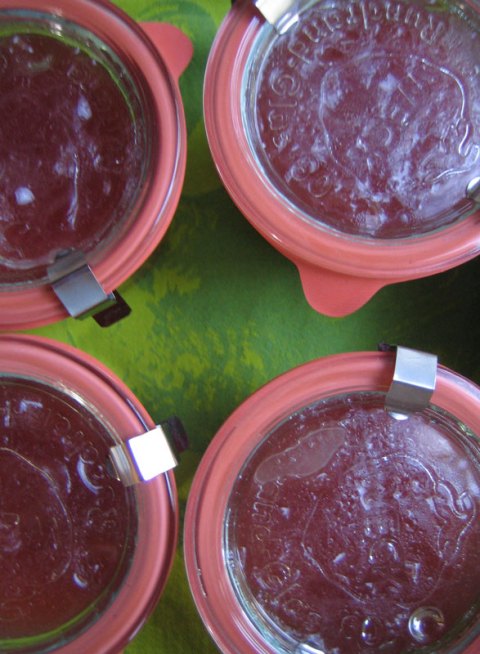
pears with heli
October 10, 2009
A few weeks ago Emily, Clint and I went to Clint’s pear tree (planted back in 1987 or so) south of town and harvested a bucket of then “slightly” unripe pears. We made some yummy pies, and the rest of the pears sat in my kitchen in the bucket, with me nibbling occasionally.

When I was talking with Heli about visiting her, I asked if she wanted me to bring the pears up for us to can. She did, so I tossed the whole collection in the back seat of the car (along with the chestnuts, and a whole bunch of last minute herbs from the garden). Today we collected the supplies for pear preserves with ginger and lemon, from The Joy of Jams, Jellies, and other Sweet Preserves, by Linda Zeidrich.
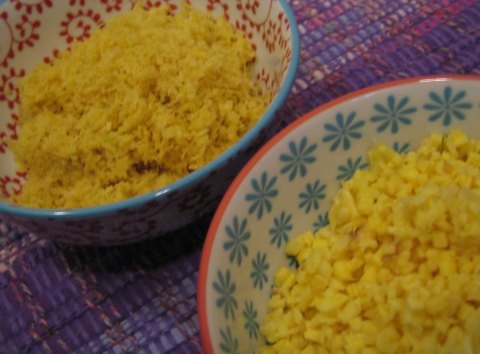
The recipe includes a generous amount of lemon zest and minced ginger, and sits out on the counter for quite a few hours. The kitchen smells lovely! A delicate mixture of pears, ginger and lemon.
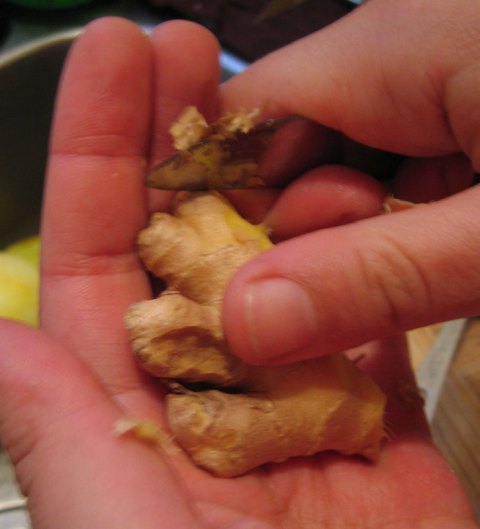
I can’t remember where I learned this, but it is a nifty trick for peeling ginger. When you are peeling fresh ginger, use the back side of a butter knife (I think that there might be a tool for this as well) to scrape the peel off. This is the easiest way to peel ginger without taking off too much of the root.

For mincing the ginger, Heli, trained in the Deli, had a little tip. Chop the ginger (or anything that you might be chopping) with your hand over the middle part of the knife finger tips up. This protects them as you chop quickly (as she is demonstrating!)
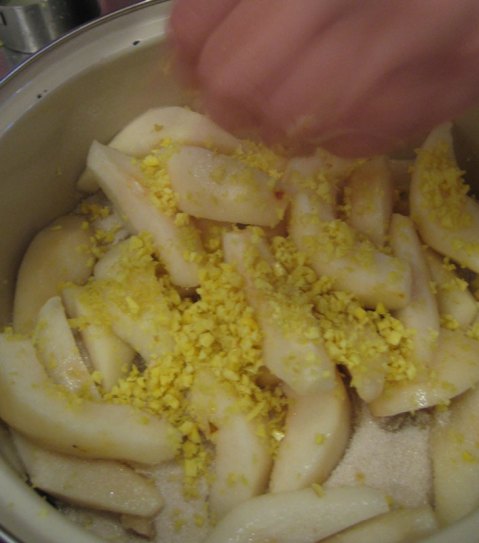 As we peeled the pears we layered them with the sugar, ginger, and lemon (as per recipe). We had fun here, with the pot in the kitchen between us, chopping and layering. Heli had a clear plan that we needed to layer 4 sliced pears and then add the sugar, etc. I accidently started adding the spices early and was clearly instructed that we hadn’t added enough pears yet…love to be back with the sister!!!

Later…
After sitting overnight, the sugar dissolved, and the pears were ready to slowly cook for several hours. We were in the kitchen, stirring the pears every so often, while we made Monte Bianco. As the pears cooked, they turned a beautiful burnt orange color. I am a little concerned though as we ended up with a lot of liquid, and not too many pears floating in it… I think that if I were to do it again I would maybe change the sugar to fruit ratio, which seemed high on the sugar side. The recipe did suggest using the pears over ice cream, which I think would be good! Or maybe with fresh cream!!

Finished pears, cooling on the window sill. Soon to be whisked off to a cool, dark cupboard for better storage.
pimento pickles
October 4, 2009
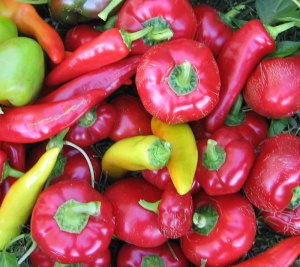
Fresh pimento peppers, with a few hot peppers as well. These peppers are at the end of the season, and nicely ripe and red!
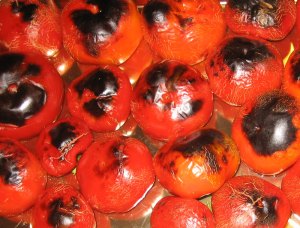
The peppers need to be roasted to remove the skins. I broil them in the oven, placing the peppers on the top rack right next to the heat coils. I like to have the skins all the way black (the above peppers are only partially blackened) before I put them in a bowl covered with a plate to sit for a few minutes until I can peel the skins off without burning myself. ( I usually burn my thumbs anyway.)
Once they are peeled and seeded they are ready to be placed in jars. It is helpful to rinse them and dry them gently with a clean tea towel (colored so that any stains are camouflaged).
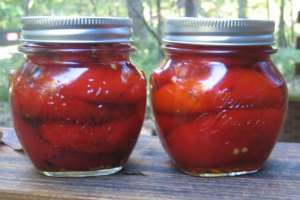
They are nicely flat, and look lovely when stacked in the jar, topped with pickling liquid (vinegar, sugar, etc.). I got this recipe from The Joy of Pickling by Linda Ziedrich. It is very simple, and can be used for sweet peppers and hot peppers!
chestnuts part three
October 4, 2009
Brenda had me over this afternoon to learn how to make sweet chestnut ravioli. This is a recipe that she came up with, and I was really excited to try it! It was a bit of work, but a wonderful way to spend the afternoon! I always love to cook with other cooks, it is the best way to learn new tricks and tips in the kitchen!!
Below I have written up an approximate recipe for what we did.

Boil chestnuts for 20 minutes, or until tender. It might be easier to peel them if they are slit with a knife or chestnut splitter first. (We just boiled them whole)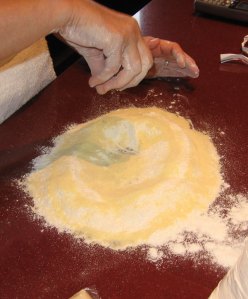
While chestnuts are boiling, mix up dough for pasta. On a clean counter, make a mound of flour. We used a mixture of white flour and semolina flour, with a dash of salt. The Semolina flour is harder and the individual grains are larger. The white flour has more gluten and is what holds the dough together. Together they make a nice combination for this dish.
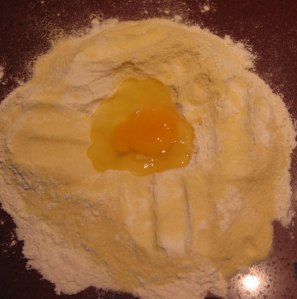
In the center of the flour mixture add eggs, one at a time. As the eggs are mixed in place the resulting dough to the side. We needed three eggs to use up our flour. Place dough in a bowl and cover. Let rest for at least 30 minutes.

While the dough is resting, peel the chestnuts, being careful to remove both the inner and outer shell. It is easier to remove the shell when the nuts are hot, so keep the majority of the chestnuts in the pot in hot water, removing a few at a time to peel. These chestnuts were so easy to peel! Many of them popped right out of their skins.

Place peeled chestnuts in a food processor. Pulse to chop until somewhat fine. Add a sprinkle of chocolate chips and some powdered sugar.

Pulse until chestnuts and chocolate chips are approximately the same size, and the mixture comes together when you mix it with your fingers.
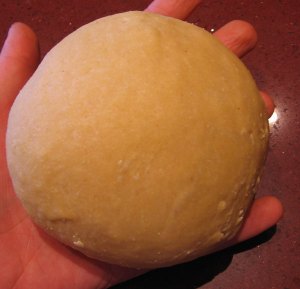
Return to the dough. It should have come together after resting, and you can knead it a little, but not too much.
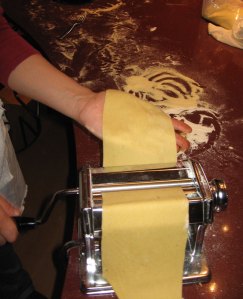
Break off a piece and run it through a pasta maker. Start with the #1, the largest setting, and roll through each setting until desired thickness. (We finished at setting #5 for our ravioli.)
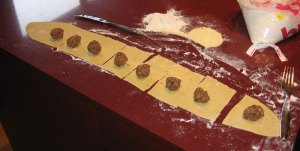
Place dough on a well floured counter and put filling on pasta. Cut out pieces, trying to keep them about the same size (so that they cook evenly).

Seal the ravioli with water or egg white, and press firmly with a fork.
We placed our finished ravioli on a well floured cookie sheet to freeze. When they were frozen, we put them into ziplock bags. Brenda deep fries them. I might try deep frying, or also just boiling them. I am going to wait until Miles, Nozomi, and Heli are around (hopefully all at the same time!) to eat them.
how to defend chestnuts
October 3, 2009

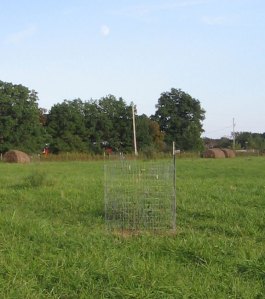
This is how I like to protect my chestnuts. Cage the trees.
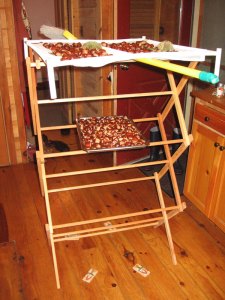
Protecting the nuts, a little more challenging.
Top layer, drying rack, supplemented by broom handle.
Second layer, additional chestnuts drying on a cookie sheet.
Ground floor, mousetraps, baited with peanut butter.
Success?
 living in the woods and making stuff