chestnuts part three
October 4, 2009
Brenda had me over this afternoon to learn how to make sweet chestnut ravioli. This is a recipe that she came up with, and I was really excited to try it! It was a bit of work, but a wonderful way to spend the afternoon! I always love to cook with other cooks, it is the best way to learn new tricks and tips in the kitchen!!
Below I have written up an approximate recipe for what we did.

Boil chestnuts for 20 minutes, or until tender. It might be easier to peel them if they are slit with a knife or chestnut splitter first. (We just boiled them whole)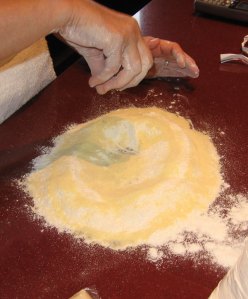
While chestnuts are boiling, mix up dough for pasta. On a clean counter, make a mound of flour. We used a mixture of white flour and semolina flour, with a dash of salt. The Semolina flour is harder and the individual grains are larger. The white flour has more gluten and is what holds the dough together. Together they make a nice combination for this dish.
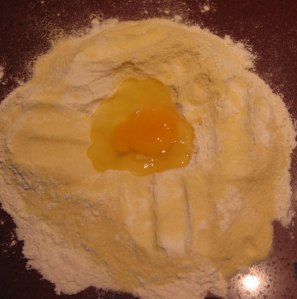
In the center of the flour mixture add eggs, one at a time. As the eggs are mixed in place the resulting dough to the side. We needed three eggs to use up our flour. Place dough in a bowl and cover. Let rest for at least 30 minutes.

While the dough is resting, peel the chestnuts, being careful to remove both the inner and outer shell. It is easier to remove the shell when the nuts are hot, so keep the majority of the chestnuts in the pot in hot water, removing a few at a time to peel. These chestnuts were so easy to peel! Many of them popped right out of their skins.

Place peeled chestnuts in a food processor. Pulse to chop until somewhat fine. Add a sprinkle of chocolate chips and some powdered sugar.

Pulse until chestnuts and chocolate chips are approximately the same size, and the mixture comes together when you mix it with your fingers.
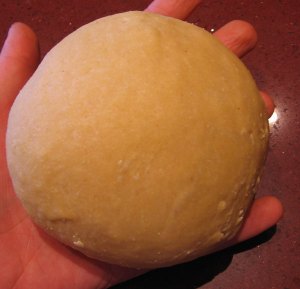
Return to the dough. It should have come together after resting, and you can knead it a little, but not too much.
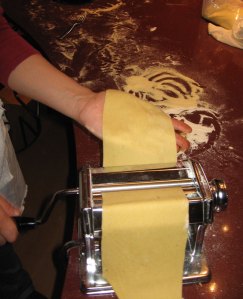
Break off a piece and run it through a pasta maker. Start with the #1, the largest setting, and roll through each setting until desired thickness. (We finished at setting #5 for our ravioli.)
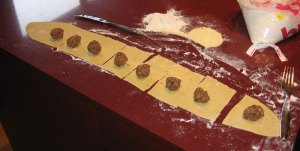
Place dough on a well floured counter and put filling on pasta. Cut out pieces, trying to keep them about the same size (so that they cook evenly).

Seal the ravioli with water or egg white, and press firmly with a fork.
We placed our finished ravioli on a well floured cookie sheet to freeze. When they were frozen, we put them into ziplock bags. Brenda deep fries them. I might try deep frying, or also just boiling them. I am going to wait until Miles, Nozomi, and Heli are around (hopefully all at the same time!) to eat them.
raspberries in vinegar, raspberries in brandy
September 30, 2009
 It seems to be the end of the raspberry season. I went to pick last night, and the berries were smaller, fewer, and farther between. And they definitely had a different taste. A little old maybe. Trying to make the most of the last bits of warmth and sunlight.

The yellow jackets were out too, practically burying themselves in the riper berries.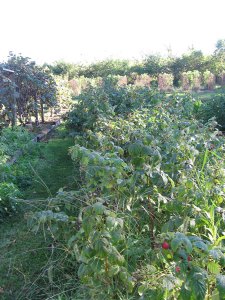 This is the raspberry patch. All the berries are planted in raised beds, with grass planted between them. This makes for slightly easier weeding and care. and easy picking too! You don’t have to bend down as much to pick the berries.

It is the end of the season, and I am getting a little tired from all the cooking, stirring, etc. So with this batch of berries I decided on something a little easier. Raspberries in red wine vinegar, raspberries in apple cider vinegar, and raspberries in brandy.
The berries are put in sterilized jars and mixed with the vinegar or brandy.
The brandy berries have to wait at least 40 days. Vinegar berries wait at least a month.
Recipes for raspberries in brandy (and a million other interesting ways of preserving foods) are from Preserving Food without Freezing or Canning: Traditional Techniques Using Salt, Oil, Sugar, Alcohol, Vinegar, Drying, Cold Storage, and Lactic Fermentation. A very interesting book compiling many traditional recipes from the French countryside. With a forward by Deborah Madison.
For recipes for raspberries in vinegar look in The Joy of Jams, Jellies, and other Sweet Preserves, by Linda Ziedrich. Another wonderful source for recipes, and lots of interesting information!
quince part three
September 28, 2009
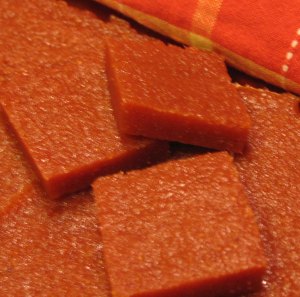
I processed another batch of quince this weekend. I think this was my favorite so far. I think that this is for two reasons. Firstly, the quinces have been ripening in my kitchen. Every time I walk into my house there is a delicate, sweet smell of quince. As they ripen, the color of the fruits turns a deep yellow, and the fur on the skin becomes easier to remove. Secondly, I made quince paste (from one of my favorite preserving books, “The Joy of Jams, Jellies, and other Sweet Preserves” by Linda Ziedrich). Quince paste is like the essence of quince. The tang, the sweetness, and the gritty and firm texture (at least in mine) are what remind me of quince.

The general idea behind quince paste is that the quince fruit is cooked, pureed, added to sugar, and cooked some more. The result is a fruit gel of sorts that I am thoroughly addicted to. All the pectin in quince (particularly in the peels, seeds, and cores) helps to gel the fruit, creating almost a cake. I am trying not to eat it every time I get near the kitchen…which is pretty much all the time that I am in my house.
Witherspoon Quince Family Trivia
After talking with my dad, I learned that my great grandmother had a huge quince tree, and that my dad and a friend used to own 20% of the quince fruit tree crop in California! This turns out to have been 12 trees, and because there was so little demand for the fruits, they ended up giving them away!
one berry pies
September 24, 2009
I have been wanting to do this for a long time. Kathy brought me some berries from the market, and I promptly ate most of them, and had to re pick some berries from the back garden. Not sure that I need to say more. Except that my mom came over half way through the baking process and the results were more perfect pies and a teddy bear picnic on my counter.


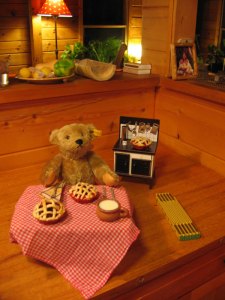
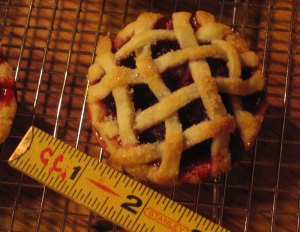

pears, pie and aprons
September 23, 2009
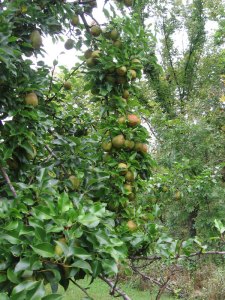
Pears, and more pears. My friend Clint planted this tree in 5th grade, and now look at it! We spent all day picking pears and apples, wandering through the fields, peeling pears, and baking pies. And wearing aprons!

This has to be the best way to pick pears! At least the lower ones. The tree is absolutely loaded. There are so many pears everywhere. We filled our entire bucket, but barely made a dent in the pear population.
Here is a general recipe for pear pie. I am not the most precise cook, so hopefully the directions are clear enough..
Pear Pie
Filling
8 large pears, or a mixture of pears and apples (The pears were a little unripe so we decided to add apples to them when we were baking.)
1 teaspoon vanilla, or a snip of a vanilla bean
3/4 cup sugar (more or less depending on the tartness of fruit)
a pinch of salt
1/4 cup flour
several dots of butter
Pie Dough
1 1/2 cups flour
1 stick unsalted butter
a little salt (I use salted butter and a bit of salt, and so does my mom..)
1/2 cup ice water
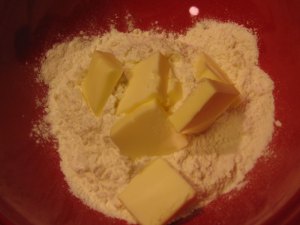
Mix flour, salt and butter with a pastry cutter until texture resembles cornmeal. Add ice water a bit at a time until mixture comes together to form a ball. Divide dough into two balls and chill at least 1/2 hr in fridge.
Meanwhile, peel, core and slice apples and pears. Place in pot, with a little water and vanilla bean. Cook until pears are soft. This step allows you to fit more fruit in the pie! Add sugar, salt, and flour. You can let the pears cool a little before you put them in the pie shell (we didn’t, but it is probably a good idea..).
Roll out pie dough, place one in pie pan, fill with filling, and place top on. Seal the edges, and poke the top with a fork.
Bake in a 450 degree oven for 10 minutes, and then bring temp down to 350. Bake for an additional 35-45 minutes, until top is nicely golden. You might need to cover the pie with some parchment paper if it gets too brown on the top early on. Remove, and cool as long as you can wait.
Yummy with vanilla ice cream!

quince part 2 (and vanilla sugar)
September 15, 2009
So, I finished the quince jelly, which turned into lightly quince flavored vanilla syrup…
I ran out of sugar, and my mom had a pretty jar of vanilla sugar. So… I decided to use the vanilla sugar for the quince and I ended up not cooking the mixture long enough (I think) and the result was that the jelly didn’t gel as much as it is supposed to.
When I had my mom sample it she was trying really hard to tell me that it tasted like quince, but since she wasn’t particularly familiar with quince, she had a hard time detecting it. So now I have three jars of quince vanilla syrup that I am planning to use to sweeten poached pears in the winter… the jars look pretty anyway, the vanilla seeds are suspended in the mixture.
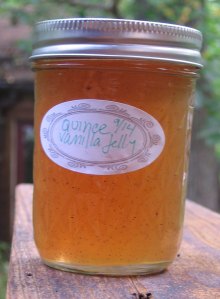
Vanilla Sugar
My mom had some really fresh organic vanilla beans from a family farm in Costa Rica. She puts several beans in for 3 or 4 cups (or more) of sugar. You can leave the bean whole, or scrape out the seeds, which mix nicely with the sugar.
This sugar works really well for lots of things! To flavor hot milk, jams, pies, spiced fruits, etc!!
quince
September 14, 2009
I am kind of obsessed with canning things. I get giddy when I find a new source for fruits or vegetables. Excited and can’t stop talking about it. Yesterday was a grape day. Today is a quince day.

Quinces are hard to find around here. Their skins and cores are full of pectin (a substance that helps “gel” jams and jellies), and make a lovely jelly. The fruit is wonderful when made into paste, jam, and sauce. My friend Jeanne from Oskaloosa has a quince tree and she is going to let me stop by and pick a bucket of quinces.
Later… Jeanne and I went out and collected some quinces. They are a smaller variety, which I think are called flowering quince. I have a recipe for flowering quince jelly which i have started.

The quinces are washed (to remove the fur on the skin) and then quartered. Their seeds are tightly clustered in the center of the fruit and are surrounded by a gel like substance (pectin?). The fruit is very hard and needs to be cooked before eating.
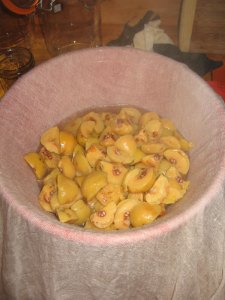
My jelly recipe uses about 3 lbs quince. I simmered the quince in my cauldron for about 1 hr until soft. They smell lovely when cooking-sweet, almost like honey. When the fruit was soft, I put them in a piece of linen cheesecloth and tied it to my cabinet. The pectin rich juice is draining into a bowl on my counter for the next 12 hrs or so..
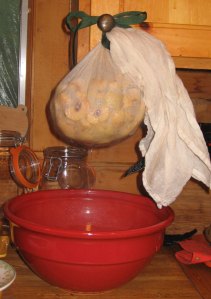
Once all the juice is collected, it will be added to lots and lots of sugar and transformed into jelly for the fall and winter!
 living in the woods and making stuff